The Shell Logo: A Century of the Pecten
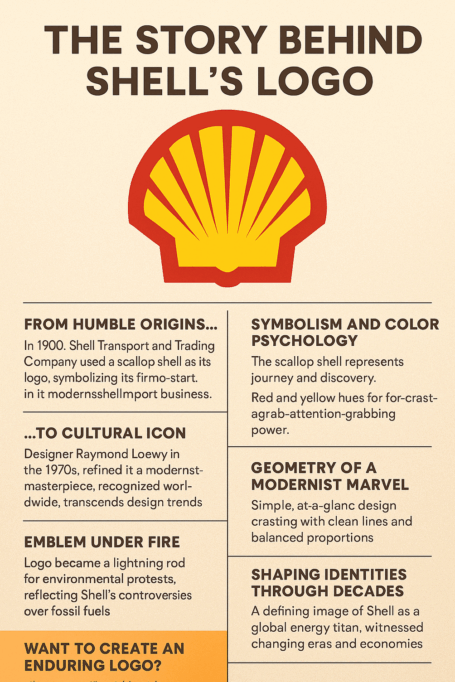
Shell is one of the few oil companies whose logo started as a literal picture of the business. The Shell Transport and Trading Company grew out of a trade in actual seashells, and the scallop it put on its signs has stayed there for more than a hundred years. In that time the shell has been simplified, recolored, praised by designers and painted onto protest banners. Few corporate marks have been loved and attacked in such equal measure, and fewer still have come through it without a redesign forced by the bad press.
From Seashells to Oil
Around 1900 the Shell Transport and Trading Company was a modest business that dealt in shells, real ones, imported from the Far East and turned into decorative trinkets. Its founder, Marcus Samuel, picked the scallop as a nod to the family trade. There was no grand branding idea behind it. The company drew what it sold. The first logo was a black-and-white scallop, functional and forgettable, the kind of mark that does its job on a crate and nowhere else.
By 1904, as the company moved into oil, the shell was redrawn with cleaner lines and a little more character. The version most people picture today came much later. In the 1970s the industrial designer Raymond Loewy, often credited with the curves of the Coca-Cola bottle, turned the shell into a bold red-and-yellow modernist mark. He treated the scallop as a shape to be simplified rather than a creature to be illustrated, and the result became a beacon for drivers and a badge for a company with global ambitions.
Why Red and Yellow
The palette is the first thing you notice, and it was chosen to be noticed. Red reads as energy and urgency, which suits a company selling the fuel that keeps traffic moving. Yellow is warmer and more optimistic, the color of a bright day at the pump. Together they are about as loud as two colors get, and on a roadside sign that is the point. You see a Shell station from a long way off.
This pairing is common for a reason. Studies are often cited claiming that red and yellow raise brand recognition by up to 80%, and McDonald’s and IKEA are the usual examples alongside Shell. For a company operating in dozens of countries, a palette that needs no translation is worth a great deal: the same shell means fuel in Tokyo and in Timbuktu. There is an irony in it too. Red is also the color of danger, which is an awkward fit for a company that spends so much time defending its environmental record.
For anyone choosing colors for their own mark, the useful takeaway is that warm tones grab attention and cool blues and greens calm things down. Pick the mood first and the colors second, and stop at two or three. A rainbow only works if your brand actually is one.
Loewy’s Modernist Shell
Loewy’s 1971 redesign stripped the shell back to its essentials. Clean lines, bold shapes, nothing extra. It follows the “less is more” thinking associated with the Bauhaus, and it is a geometric drawing as much as a natural one. The ribs fan out in an even rhythm and the outline is close to symmetrical. The curves and symmetry are often said to follow the golden ratio, the proportion artists have used since ancient Greece.
That simplicity is practical. A modernist mark has to be clear and it has to scale, and the 1971 shell looks as sharp on a pump nozzle as on a billboard or the cover of an annual report. Smooth curves and balanced proportions mean you can recognize it at a glance, from a moving car, in poor light. A mark that lands fast is worth more on a motorway than one that rewards close study.
The 1971 design also became a reference point. It is hard to look at the clarity of later global marks, Apple’s bitten fruit or Nike’s swoosh, without seeing the same priorities: one shape, instantly scalable, no reliance on words. Shell did not invent that approach, but it showed early how well it could work for a company that needed to look the same in every country. The modernist idea that form should follow function runs through it. The shell tells you the company is efficient, and implies that you will be too if you fill up there.
If you are working on a minimal mark yourself, start with simple shapes and keep adjusting until the result looks effortless. If it looks like it is trying hard, it probably is.
Brent Spar and the Shell as a Target
The logo’s fame cuts both ways. In the 1990s Shell faced a public relations disaster over its plan to sink the Brent Spar oil platform in the North Sea. Greenpeace activists painted the shell onto protest banners, and the cheerful scallop turned into shorthand for corporate greed. Seeing a familiar, friendly symbol used that way was jarring, and that was exactly why the protesters chose it. The backlash forced Shell to dismantle the platform on land instead, a costly retreat.
More recently, climate activists have made the logo a regular feature of online campaigns. #ShellKnew drew attention to what the company knew early on about the climate impact of fossil fuels, and the shell appeared across memes and placards. For some people the red-and-yellow mark that once stood for progress now works more like a scarlet letter. Shell has kept using it, including on its “net-zero” initiatives, which critics call greenwashing. The same recognizability that sells fuel makes the logo an easy thing to aim at.
The lesson for smaller brands is simple and slightly uncomfortable. A logo becomes the face of whatever the company does, good or bad, and the internet keeps the receipts.
Does a Logo Move the Share Price?
Probably not directly. Shell’s stock (LON: SHEL) follows oil prices, geopolitical shocks and ESG (environmental, social and governance) pressure far more than anything its designers do. What the logo provides is continuity. Through all of that volatility, the face of the company has stayed the same, and a familiar mark builds a kind of trust that does not depend on the quarterly numbers.
In 2020, when oil prices collapsed during the pandemic, Shell’s shares fell to £9. The brand itself did not wobble in the same way. People still recognized the shell and assumed Shell would be around, which matters to customers and investors alike. By 2025 the stock was around £25, helped by energy demand and the company’s moves into renewables. The logo had not changed at all. That kind of consistency is a quiet signal of reliability, and it argues for designing for the long run rather than chasing whatever flourish is fashionable this year.
A Logo That Tracks the Decades
You can read the century through Shell’s shell. The versions from the 1920s were more detailed, with an industrial confidence that fits alongside the ornament of Art Deco. Loewy’s 1971 redesign matched a decade preoccupied with speed and efficiency, the era of muscle cars and motorway service stations. In the 1990s the logo spread across a globalizing economy and came to stand for multinational scale.
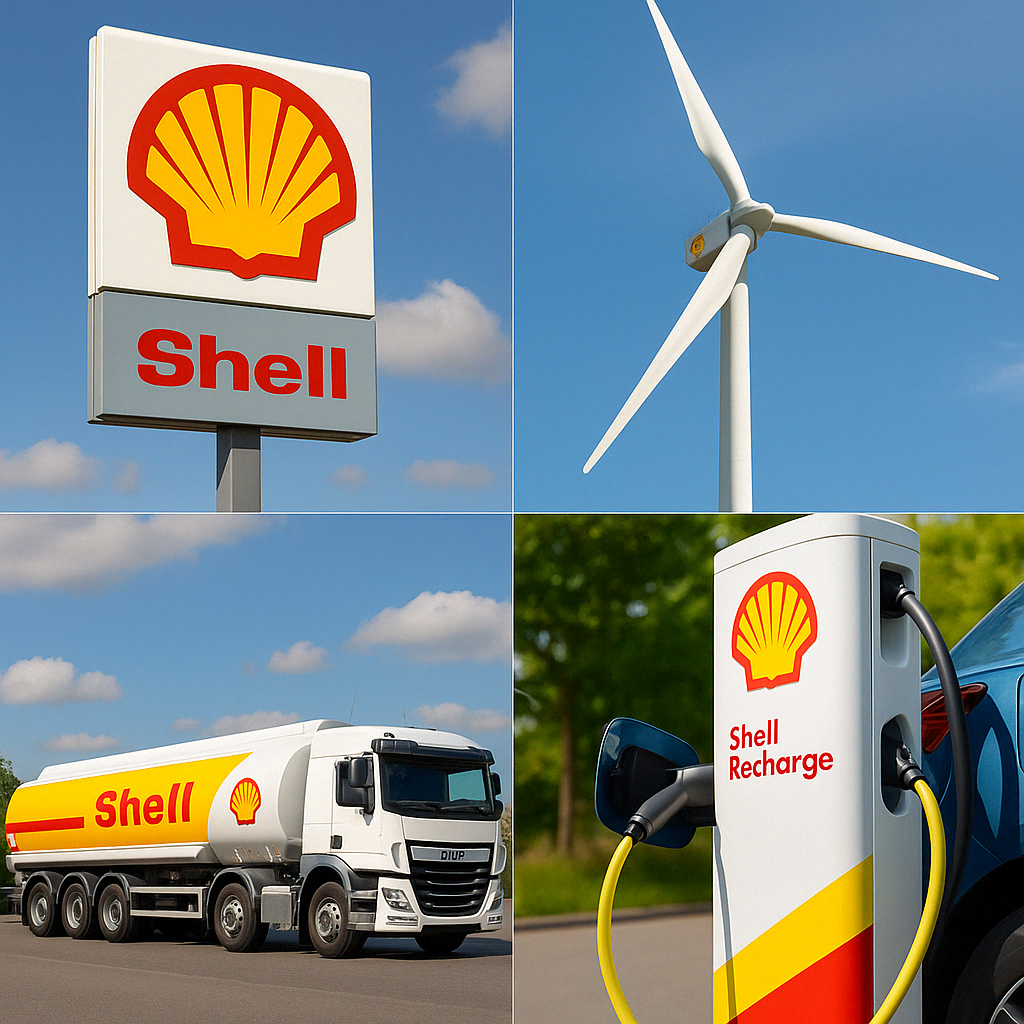
Now it sits between two worlds. Shell’s “Powering Progress” strategy puts the shell on wind farms and EV chargers, which signals a shift, or at least the appearance of one. The mark is trying to look at home on green infrastructure while everyone still associates it with petrol forecourts. That tension is not really a design problem. It is the same tension most energy companies are living with, and the logo simply shows it. The general principle holds, though: a logo can follow a company into new territory as long as its core shape stays put.
Three Things Shell Gets Right
- Simplicity. Clean lines and two bold colors cut through roadside clutter and stay in memory. Resist adding detail you would have to explain.
- Color with a purpose. Red and yellow were chosen for visibility and mood, not prettiness. Choose colors that fit what your brand is trying to make people feel, and test a few palettes side by side before committing.
- Versatility. The shell works on petrol stations, annual reports and, less happily for Shell, protest signs. Design for every size and surface you can think of: screens, print and merchandise.
One side effect of all this: the shell has been copied endlessly, by local garages and by parody T-shirts. Being imitated is flattering, but the original still owns the idea.
What a Scallop Means
The scallop has a long history before Shell. In medieval Europe it was the badge of pilgrims walking to Santiago de Compostela, and it came to stand for the journey, discovery and endurance. Shell’s founders probably liked those associations, and for a company whose business depended on exploring for oil, the fit was neat.
Later readings piled on. The ribs and curves suggest waves, and so the movement of energy. The symmetry suggests balance and reliability. Critics read it differently, as a glossy surface over environmental damage. Symbols are slippery that way; they end up meaning what the people looking at them want. If you choose a shape for its cultural weight, a tree for growth or a star for ambition, remember that you only get to start the conversation about what it means.
A Logo That Divides
Shell’s logo is tied up with mobility: cars, trucks, planes. In many developing countries a Shell station is part of the basic infrastructure that keeps local economies running, and there the shell can signal progress and the promise of a modern life.
That presence also makes it a target, for groups from Extinction Rebellion to Indigenous communities fighting pipeline projects. Social media amplifies it, and hashtags like #BoycottShell have turned the shell into a digital dartboard. At the same time the logo keeps turning up in popular culture, in Hollywood chase scenes and hip-hop lyrics. It is hard to think of a corporate symbol that more people feel strongly about in both directions. A logo that is easy to share is also easy to mock, and a designer should consider both outcomes.
The Principles, Checked Against Shell
- Memorable: one look is enough.
- Simple: no ornament, just the shape.
- Versatile: it works from a favicon to a billboard.
- Relevant: the shell ties back to the company’s origins and to the idea of exploration.
- Timeless: the 1971 drawing still looks current decades later.
Most logos fail at least one of these. Shell passes all five, which is rarer than it sounds. If you are testing your own designs against the list, AI logo tools such as Semplr make it quick to produce variations and see which ones still hold up at small sizes.
The Shell as Identity
For Shell the logo is the company’s identity distilled into one shape. It stands for a promise of energy, reliability and global reach, and it is the first impression in everything from advertising to investor presentations. It says the company is big, confident and not going anywhere.
Identities shift, though. The move into renewables has stretched what the shell is supposed to mean, linking it to wind turbines and solar panels. Critics think the stretch is too far; supporters see a company adapting. Either way the logo is being asked to grow with the business, and it is a bumpy process. Universities face a version of the same problem with their crests, and it is worth looking at how others build a mark around their core values and then test it with the people who will live with it.
Taking the Shell Apart
- Shape: the scallop’s curves are organic but precise, halfway between nature and engineering.
- Color: red and yellow, for visibility and emotion.
- Negative space: the white areas of the shell stand out against the colored ground and give it contrast.
- Typography: early logos included the name. Now the shell stands alone as a wordless symbol.
Every part has a job, and none is decoration. That is the test worth applying to your own work: for each curve and color, ask whether it adds meaning or is just there. Be ruthless about the answer.
What the Shell Says
The logo says global, dependable and dynamic without a single word. It is a split-second pitch, and it delivers that pitch reliably. Communicating instantly is the main job of a logo, and Shell’s does it about as well as any.
The message is not fully under the company’s control. Where one driver sees a lifeline, an activist sees a climate culprit. Shell has to keep its message positive in front of a skeptical public, and that is a hard balance to hold. For your own mark, get feedback from people outside your circle before you commit. They will see things you can’t.
The Shell Online
The logo is far older than the hashtag, but it has done well in the social media era. It appears in #ShellStation selfies and in #StopShell protests, cheerful in one post and accusatory in the next. A strong, simple visual travels, whoever is carrying it.
That simplicity is what makes it easy to meme, whether in a viral video or a sarcastic post. Shell’s marketing team uses it in polished Instagram campaigns, but it cannot control the conversation, and activists can borrow the logo just as easily. When you design a logo with social media in mind, keep it bold, clear and easy to share, and accept that sharing works in both directions.
From Hand-Drawn to Vector
Technology has shaped the logo as much as any designer. Early versions were drawn by hand and limited by what printing could reproduce. Vector graphics made the shell infinitely scalable, so the same file now serves a pump sticker and a stadium screen. Once logos were freed from the printed page, Shell’s could appear anywhere in the world in exactly the same form.
Today an AI logo generator could produce something close to the Shell mark in seconds. Shell itself uses technology to push the brand, from AR-enhanced advertising to blockchain-tracked energy projects. Whatever the platform, the shell is the constant that ties it together. Prototyping tools are useful to professionals as well as beginners, mainly because they make it cheap to try many directions before choosing one.
Why It Lasts
Shell’s logo has outlived the seashell trade that produced it, every oil shock since 1904 and decades of protest. It got there by being a simple shape in two loud colors, drawn well once in 1971 and then left alone. It also shows the downside of success: once a logo is that recognizable, it belongs partly to the public, and the public will use it to say what it thinks of you. No logo is neutral, and Shell’s least of all.
If you take one thing from it, make it the order of operations. Keep the shape simple, make sure it works everywhere, and make it tell a story that is actually yours. That holds whether you sketch by hand or use software.
To try this on your own brand, start a design at semplr.com.