The Starbucks Logo: How the Siren Became an Icon
The Starbucks siren started life as a bare-breasted, twin-tailed figure lifted from a 16th-century Norse woodcut, printed on the bags of a single Seattle coffee-bean shop in 1971. Over four decades the company covered her up, cropped her in and finally took its own name off the logo altogether. The green circle that resulted is now so familiar that most people would recognize it from across a street, with no lettering at all.
That is a lot of change for a logo that still feels like the same one. Each step made it simpler, and each step was a bet that customers already knew who the siren was.
A Siren From a Woodcut
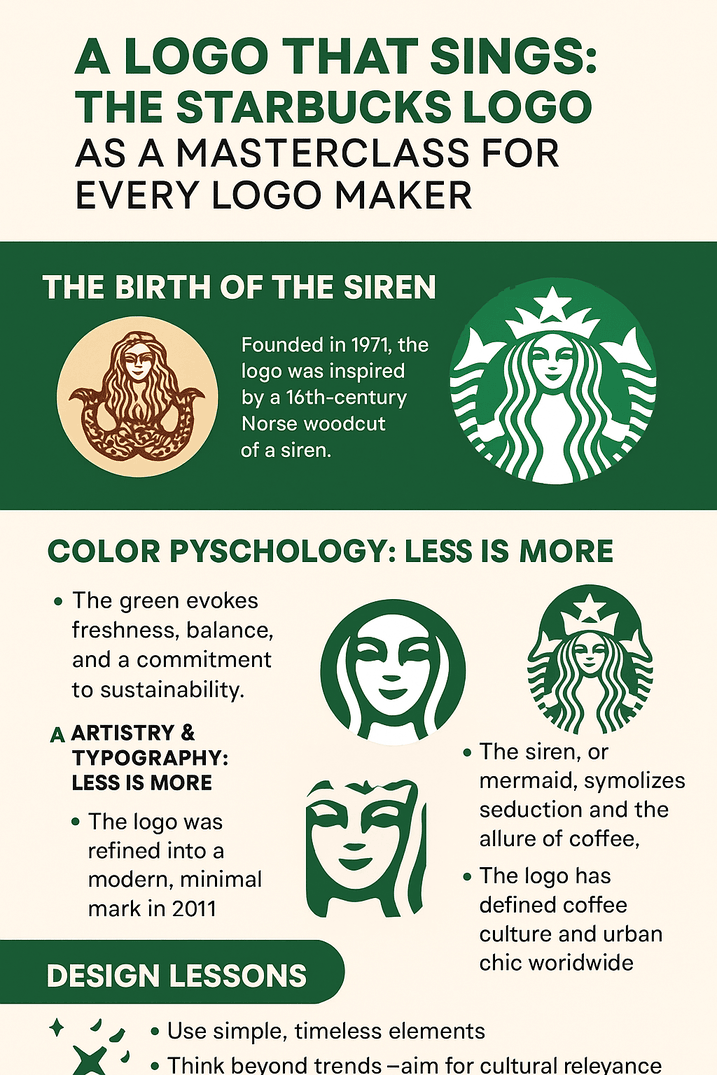
In 1971 Starbucks was a small Seattle shop selling coffee beans. Its founders, Jerry Baldwin, Zev Siegl and Gordon Bowker, wanted a logo that said coffee with a nautical flavor. They found it in a 16th-century Norse woodcut of a siren, or mermaid if you prefer. She was bare-breasted and twin-tailed, taken from sea lore, and she stood for seduction and the pull of the sea. Applied to a coffee shop, the joke was obvious: the cup you cannot resist.
The original logo was rough and unpolished, and a little cheeky. That suited a business trying to lure people into a new kind of coffee culture. It looked old, and in a market of supermarket tins, old meant authentic.
Why the Logo Is Green
The green is doing more work than it looks. Like any brand color, it is a psychological choice. Green suggests freshness, sustainability and calm, which fits a company that talks about ethically sourced beans and comfortable cafés. It is also a color that makes people feel settled, which is useful for a business that wants you to stay, drink and spend.
For anyone making a logo, color is the first thing an audience notices. Tools like Looka or Canva make it easy to try palettes, but it helps to look at how Starbucks itself specifies its logo: one green, used consistently, telling the brand’s story before anyone reads a word.
Less Lettering, More Siren
The new Starbucks logo arrived in 2011. It dropped the outer ring of text and zoomed in on the siren’s face. The sans-serif lettering of earlier versions disappeared and left a wordless emblem, which was a confident move. Starbucks no longer needed to spell out its name. The siren had become shorthand for coffee around the world.
This is a lesson in restraint for anyone using a logo creator. AI tools like Semplr make it easy to keep adding fonts and shapes, so the discipline is in what you leave out. A logo works best when it speaks quietly and does not shout.
What the Siren Means
The siren, linked in myth with the figure of Melusine, stands for enchantment and danger at once. Starbucks used both sides. Its coffee is presented as a daily ritual and as a small indulgence. The twin tails, much more visible in earlier versions, are said to nod to the sea trade routes that carried coffee around the world.
The general lesson is to think in symbols. What is at the heart of your brand? A fox for cleverness? A tree for growth? Tools like BrandCrowd can help turn ideas like these into images, but the idea has to come first.
Why It Has Aged Well
The logo has changed four times since 1971, each version cleaner than the last. The core has not moved: green, circular, with the siren at the center. That balance of change and consistency is why it feels modern and timeless at once, a bit like a classic song in a fresh recording.
Timelessness usually comes from simplicity and the ability to adapt, and the siren has both. She works on a paper cup, an app icon and a billboard without any adjustments.
How the Logo Shaped Coffee Culture
From one Seattle shop to around 38,000 stores worldwide, the logo has changed how people think about coffee. Starbucks sold a drink, but it also sold a way of living. The siren on cups, aprons and Instagram feeds became a badge of city life, and the pumpkin spice latte craze showed how far that badge could carry a product.
A logo is a cultural signal as well as a picture. When you design one, think about what it will mean to people who see it every day, not just how it looks on a screen.
Controversies
The siren has attracted criticism. The original 1971 design drew attention for its topless figure, and a more modest redesign followed in 1987. In 2006 a Christian group in San Diego called the logo “too suggestive” and compared the siren to a “slattern.” More recently, Starbucks has been accused of cultural appropriation over its Ethiopia-inspired blends, with critics arguing that the siren’s exotic appeal glosses over coffee’s colonial history.
Controversy keeps a brand in the news, but it is not something to plan for. It is worth thinking about how a logo might be read, or misread, before it goes public. Tools like Hatchful make it easy to produce variations to show people, and a small test group will tell you more than any tool.
The Siren and the Share Price
Starbucks’ branding has supported remarkable growth. As of May 2025 its market capitalization was around $100 billion, and the logo plays a real part in customer loyalty. Every cup carried out of a store is a small advertisement.
For entrepreneurs, that is the business case for good design. Time spent getting a logo right, with an AI tool or without one, is an investment, not decoration.
Consistency
The siren is recognizable everywhere, from a Tokyo storefront to a TikTok filter. That consistency builds trust, and trust is part of why Starbucks can charge $5 for a latte.
If you are using a logo creator like Canva, check that your design works at every size. A logo that looks great on a website but blurs on a business card is a beginner’s mistake.
Design Lessons
Three lessons stand out. Simple shapes scale. Symbols matter. And a logo can change a great deal without losing what makes it recognizable. The best logos end up feeling inevitable, as if they had always existed. Study the Starbucks versions side by side, then try your own ideas in an AI logo generator and compare.
What the Logo Says
The logo sells coffee, but mostly it sells a feeling. Its clean lines and green color say premium but approachable. Think about the story your own logo tells. Tools like Looka let you adjust shapes and colors until they fit the message.
The Siren on Social Media
Search #Starbucks on Instagram and you will find millions of posts, many with the logo in plain view. The siren’s presence online is not an accident; a cup with a clear logo is made to be photographed. A new logo should be easy to share, too, and it needs clean files, without watermarks, that look good on social media.
Technology and AI in Logo Design
AI is changing logo design, and Starbucks’ minimal approach fits the clean style that AI logo generators tend to produce. Tools like Semplr or BrandCrowd use machine learning to produce professional-looking designs in seconds, which puts branding within reach of startups and one-person businesses.
The tools are best seen as support for designers rather than replacements. Even a team like Starbucks’ could use them to test color variations or smooth out curves faster than by hand.
If Starbucks Had Used an AI Logo Generator
Imagine the Starbucks design team in 2011 typing “siren, green, coffee” into an AI logo generator. Would Looka have suggested a bolder flip of the tail? Would Canva have offered a gradient? The result might have landed close to the real logo, which says something about how far the 2011 design had already been simplified.
A prompt like “coffee siren” will typically return a neat, circular emblem with a cartoon mermaid. That can be a decent starting point, but it lacks the history that makes the Starbucks siren feel like more than a mascot. AI is a tool, not a source of ideas.
How to Make a Logo With AI
If you want to try it yourself, here is a simple process:
- Choose a platform. Free tools like Looka, Canva and Hatchful are easy to use and offer downloads without watermarks.
- Define your brand. Enter keywords that capture the feeling you want (for example, “modern, bold, tech”).
- Try colors. Use Starbucks’ green as a reference and choose a color that creates the right emotion.
- Keep it simple. Avoid clutter; the 2011 Starbucks logo shows how much can be removed.
- Test the scale. Make sure the logo looks sharp as a favicon and on a billboard.
- Get clean files. Tools like BrandCrowd provide professional files without watermarks.
What the Siren Teaches
The Starbucks logo has survived controversies, helped define modern coffee culture and inspired endless imitations. Its strength is not flash. It is that every redesign removed something and the siren was still there.
If you are starting a logo of your own, try drafts in Looka, Semplr or Canva, then keep cutting until only the idea is left.