The Vans Logo: Skate Culture in Black and White
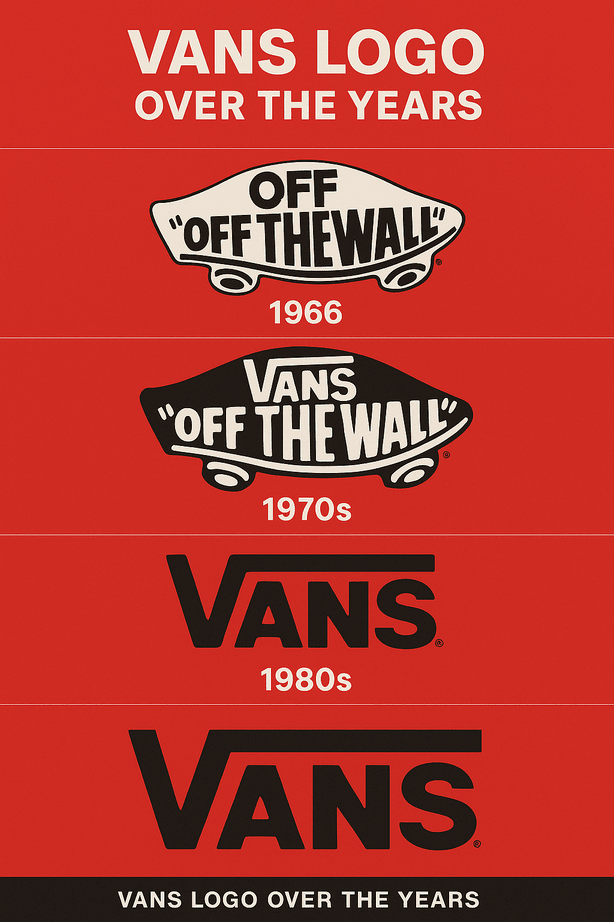
The Vans logo started as plain lettering on the shoeboxes of a single shop in Anaheim, California, opened in 1966 by Paul Van Doren and his brother Jim. Nobody designed it to be a symbol of skateboarding. Skaters made it one, by wearing the shoes until the name stood for a whole way of life.
From an Anaheim Shop to Everywhere
The Van Doren brothers sold sturdy canvas shoes, made on site, to customers who mostly wanted something that lasted. The first logo matched the product. It was a simple, blocky “Vans” set in a heavy sans-serif, chosen for usefulness rather than style. It was not produced in a design studio and it did not look like the mark of a company that would one day sell shoes in Paris boutiques.
The big change came in the 1980s, when the “Off the Wall” tagline and its skate-inspired emblem took center stage in Vans’ branding. The phrase came from skateboarding slang, and the emblem gave the people who already wore Vans, skaters and other kids who did not fit in, a badge of their own. From then on the brand stood for rebellion, creativity and the do-it-yourself attitude of skate culture. It was identification more than salesmanship, and it worked.
Black, White and a Little Red
Vans uses color sparingly. The logo is almost always black and white, with an occasional red accent in some versions. Black reads as solid and timeless; white keeps the mark clean and easy to like. That combination suits a brand that has to look right in a skatepark and on a fashion runway. The red, when it appears, adds a jolt of energy.
Color is usually the first thing people register about a brand, before they read anything. Vans’ restraint means the logo can go on sneakers, T-shirts, hats and skate decks without ever clashing with the product. Nike relies on the shape of the swoosh and Converse on its star badge. Vans relies on bold lettering in black and white, and it gets noticed without having to compete for attention.
The Lettering
The typography is the core of the logo. The bold sans-serif wordmark, sometimes said to be a customized version of Helvetica, is confident without strain. The letters are thick and chunky, much like the shoes: built to take a beating. The “Off the Wall” version is looser and more hand-drawn, closer to a graffiti tag on a Venice Beach wall, and the two together give Vans a formal voice and a casual one.
That mix of structure and attitude is deliberate. Good type sets a mood without calling attention to itself, and Vans’ lettering suggests skate grit and long-lasting cool at once. Because it relies on clean lines and very little decoration, it has adapted easily across decades, from the checkerboard slip-ons of the 1980s to collaborations with Supreme and Fear of God today.
What the Marks Suggest
The “V” in the classic logo stands tall, a little like a skater mid-ollie, while the “Off the Wall” emblem, with its curved lines, hints at a board carving through a halfpipe. Neither shape is literal, but both suggest movement and freedom, which is exactly what the brand sells.
Compare that with Louis Vuitton’s monogram, which signals luxury, or Gucci’s interlocking Gs. Those are marks of exclusivity. Vans’ marks are the opposite. They belong as much to a kid grinding rails in a suburban park as to someone walking into a show at Paris Fashion Week, and that openness is a large part of their appeal.
Why It Has Not Needed a Redesign
In 2022 there was talk of a Vans logo redesign, but the company made only small tweaks rather than a real overhaul. That was sensible. The logo’s modernist basics, clean lines and bold shapes, have aged well, and it shares that quality with marks like Apple’s bitten apple and the Adidas three stripes. Simple marks have less in them to go out of date.
A modern logo has to be flexible and memorable at the same time, and Vans manages both. It looks as current on a 2025 sneaker release as it did on a 1970s skate deck. If you are designing a logo now, by hand or with software, that is the standard: keep it simple, keep it bold, and make sure it works across every medium you will use.
Through the Fashion Eras
The logo has fit a surprising number of scenes. In the 1970s it belonged to Southern California skaters. In the 1990s it was part of the grunge and punk wardrobe, down to the muddy outfits of Nirvana’s festival days. In the 2000s it moved into high fashion through collaborations such as Vans x Marc Jacobs, blurring the line between streetwear and designer clothing. Today it is a Gen Z staple on TikTok and street style blogs.
Each of those periods shows how well the logo travels. It works as a marker of time and place, and what Vans sells is as much an attitude as a shoe. Converse’s All Star logo leans on nostalgia and Puma’s feels sportier, but Vans’ fits in almost anywhere.
Knockoffs and Criticism
Popularity brings imitators. Fast-fashion shops are full of cheap shoes with “Vans-like” logos, which chip away at the brand’s credibility. In 2019 Vans sued Primark over copycat designs, a sign that the company will defend its trademarks. Vans has also faced criticism, much of it on X, for selling Native American-inspired patterns without proper acknowledgment.
Arguments like these show how much the logo carries. It has become a focus for wider debates about culture and ownership, and a logo is only trusted as long as the company behind it keeps its promises. Vans has mostly handled the criticism by leaning on its skate roots and responding directly, rather than hiding behind the brand.
The Logo and the Business
VF Corporation bought Vans in 2004, and its stock (VFC) has risen and fallen with the brand ever since. VF has leaned on the Vans name and logo to drive growth, and by 2023 the brand was contributing more than $4 billion in revenue. The logo’s presence on sneakers, clothing and even skateparks made Vans the most valuable brand in VF’s portfolio.
Nike’s swoosh sits on top of a $50 billion business and Adidas has its three stripes. Vans is much smaller, but it shows how far a strong identity can carry a company that does not have the marketing budgets of the giants.
Consistency
Vans is consistent about how the logo appears. On a classic Old Skool or on a limited-edition collaboration with The Simpsons, the mark is instantly recognizable. That steadiness builds trust, and it makes each new product feel like part of the same story instead of a one-off.
The lesson for a small brand is that the logo itself is only half the job. A tool like Looka or Canva can produce a sleek design quickly, but if it looks different on your website, your merchandise and your social accounts, the brand ends up feeling like a playlist with no theme.
What to Take From It
A few habits explain why the Vans logo has lasted:
- Keep it simple. Complicated logos age badly, and Vans’ clean lines have held up for decades.
- Know who it is for. The skate feel works because it is real; skaters adopted the brand before the brand marketed to them.
- Make it versatile. The same mark has to work on a shoe, a shirt and a billboard.
- Use color deliberately. Black and white do not date, and a small accent color adds personality.
You can apply the same principles with free tools such as Semplr or Hatchful. Enter your brand name, pick a playful or minimal style, and adjust until it looks like your business. The software will not supply the character of your brand, though. That part has to come from you.
Speaking Skater
The bold type comes across as confident, while the “Off the Wall” emblem adds a hint of rebellion. Together they match the brand’s message: live freely, make things and do not take yourself too seriously. That is why the logo feels more like a friend than a corporate stamp.
Adidas’ stripes are about performance and New Balance’s “N” is understated. Vans’ visual language is playful but grounded, which is a hard balance to hit. The best logos manage to say something about a brand without needing any words beyond its name.
On Social Media
Search #VansLogo on X and you will find a stream of fan art and custom sneaker designs. Tags such as #OffTheWall and #VansCustoms spread the logo further and turn customers into unpaid ambassadors. That is partly by design: Vans encourages user-generated content and treats the logo as something fans can play with.
For a newer brand, that is the useful lesson. A logo now has to work as a hashtag and a meme as well as a mark. You can make a design that is easy to share, but whether it spreads is up to your audience.
Technology and AI
The Vans logo was drawn in an analog era, but new logos are mostly made on screens, and increasingly with AI. Tools such as Looka, Semplr and Canva let anyone produce a logo in minutes without design training. They take your brand name, industry and style preferences and return options that can look professionally made.
The limitation is obvious. Software gives you options; it cannot decide which story your brand should tell. For a small business on a budget, free tools without watermarks, such as Hatchful or Wix Logo Maker, are a reasonable way to get a professional-looking logo, but it only becomes yours once you shape it around the personality of the business.
Beyond Sneakers
The logo appears on much more than shoes: hoodies, tees, backpacks, socks. Vans’ custom sneaker platform lets fans design their own pairs with the logo front and center, and events such as the Vans Warped Tour and House of Vans pop-ups tie the brand to music and skating, with the logo as the common thread.
The brand has also had to prove it can bounce back. In 2024 VF Corporation announced a strategic review to streamline its operations, with Vans at the center of it. A collaboration with Japanese artist Shigenori Soejima on Persona-themed sneakers drew attention and showed the logo could cross into gaming culture too.
In February 2024 Vans launched a premium label, OTW by Vans, to rework its best-known shoes. The brand is remixing classics like the Old Skool with tough Vibram soles, Dyneema fabric and rotary lacing, and adding metal rivets and multi-colored mesh knits to the Authentic 44, alongside collaborations with artists such as Sterling Ruby. New global brand president Sun Choe, who came from Lululemon, is betting on these more adventurous designs to win back Vans’ cool and reverse falling sales. OTW takes its name from “Off the Wall,” and the idea is to push the brand into new territory without losing what made it.
Vans Against the Competition
Nike’s swoosh is all motion. Converse’s star is nostalgic and tied to rock and roll. Adidas’ stripes are bold but sporty. Vans stands out for how well it moves between settings, from the skatepark to the runway, which few competitors manage. Its simplicity and its roots in a real subculture give it an edge in streetwear.
If Vans Used an AI Logo Generator
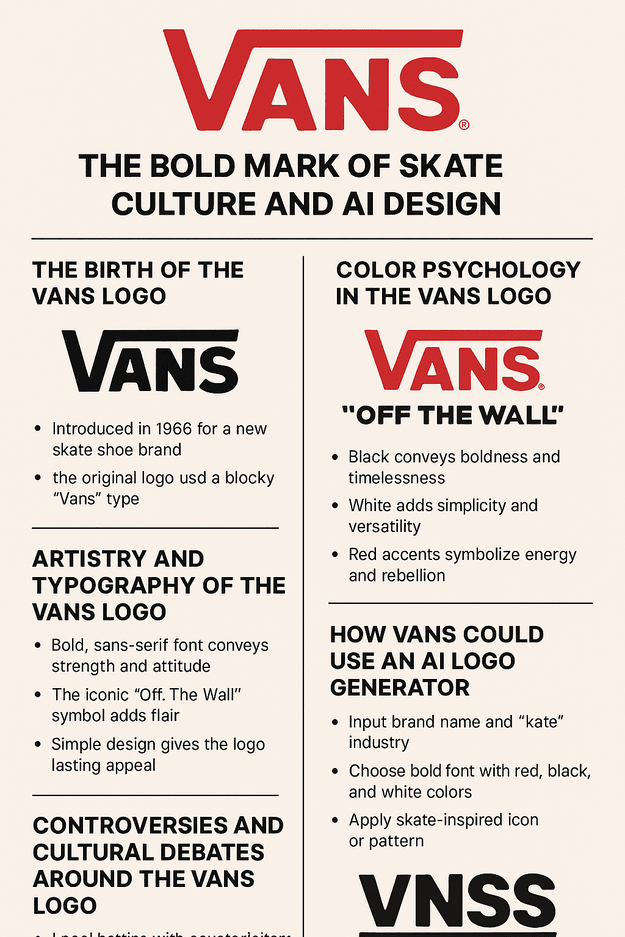
Suppose Vans wanted a refresh in 2025 and started with a generator like Looka. Someone would type “Vans,” choose “streetwear” as the industry and pick a bold sans-serif. The tool would return dozens of options, some sleek and some playful. Vans’ designers would then adjust the colors (black, white, perhaps a red accent) and add a skate-inspired icon to keep it tied to the brand’s roots.
The result might well be fresh and familiar at once, and downloadable without a watermark. In practice, though, the current logo is strong enough that Vans would probably just tidy the edges.
Vans in 2025
Vans is still one of the biggest names in streetwear. A recent post on X celebrated a collaboration with the street artist Banksy on a limited-edition sneaker, with the logo prominent. VF Corporation’s first-quarter 2025 earnings call pointed to growth for Vans in Asia, helped by how well the logo is known worldwide. The economy is tough, but the brand is still a cultural force, and the logo is what holds it together.
Designing Your Own
The Vans logo shows that a design does not need to be loud to last. It needs to be simple, honest about who it is for and used the same way every time. If you are starting a logo of your own, Looka, Semplr or Canva will get a first draft on screen: type in the name, try a few colors and fonts, and keep the ones that are bold and simple enough to survive on a shoe.