The Subway Logo: How It Evolved and Why It Works
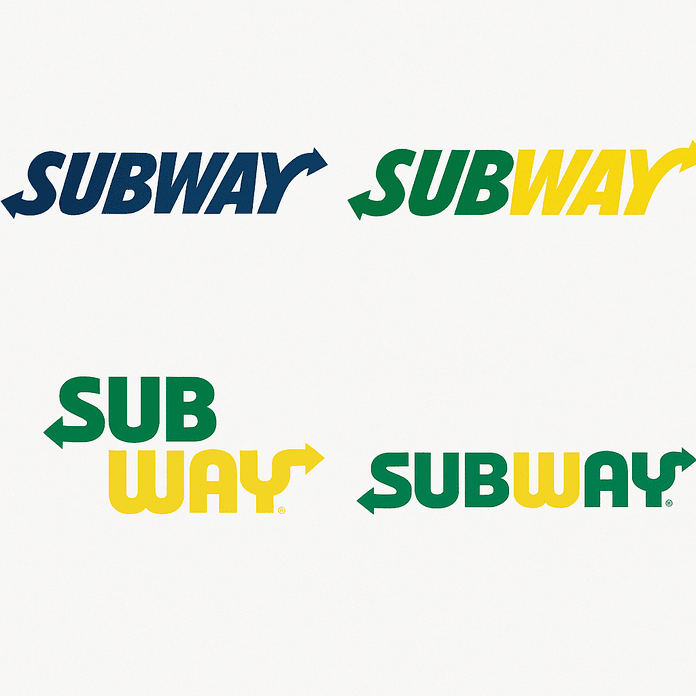
Subway started in 1965 as Pete’s Super Submarines, a single shop in Bridgeport, Connecticut, paid for with a $1,000 loan. The logo that grew out of it, green and yellow with an arrow at each end, is now one of the most familiar marks in fast food. It is simple, it is cheerful, and it has said more or less the same thing for decades: quick food, made your way, and fresher than a burger.
It is also a logo that has had to survive a lot. Questions about how healthy the food really is, thousands of store closures and an endless line of imitators have all landed on the brand, and the mark has come through mostly intact.
From Pete’s Super Submarines to Subway
In 1965 a young Fred DeLuca borrowed $1,000 from a family friend, Peter Buck, and opened Pete’s Super Submarines in Bridgeport. The first logo was a clumsy, nautical play on submarines, set in a chunky typeface that looked more like a local diner than a future global chain. The name changed to Subway in the 1970s, and the logo slowly started to take its familiar form. By 2002 the green-and-yellow design with bold arrows had arrived, and it stood out in a fast-food landscape dominated by burger chains.
The early logos were earnest but unpolished, which is how most logos start. Clarity usually comes through iteration, and Subway took a few decades to get there. The modern version knows what it is: approachable, fairly healthy, and built around the idea of a sandwich assembled in front of you in a minute or so.
Green and Yellow
Green reads as fresh, natural and healthy, which was a smart signal for a chain setting itself against greasy competitors. Yellow reads as optimistic, energetic and affordable. Together they make customers feel good about lunch before they have ordered it. Both are appetizing colors, and the pairing does exactly what the brand needs.
Green suggests balance and yellow suggests fun, so the logo promises a meal that is wholesome without being dull. That fits Subway’s pitch: quick, customizable food you do not have to feel guilty about. The lesson for any designer is to choose colors that tell the brand’s story, and to be honest about whether the product can back that story up. (More on that below.)
Type and Arrows
The lettering is restrained: a clean, bold, unpretentious sans-serif that says the company is here to feed you, not to impress you. The arrows are the clever part. One comes off the S and one off the Y, pointing in opposite directions, and they suggest movement, choice and the many ways a sub can be built. It is minimal, but every piece has a job.
Next to the ornate monograms of luxury brands like Louis Vuitton, Subway’s logo is an everyday mark, democratic and unfussy. That is the right choice for a sandwich shop. A simple shape or a clever detail in the letters can carry more weight than a dozen decorative flourishes.
What the Arrows Say
The arrows are not just decoration. They work as a welcome: come in, choose what you want, leave happy. They also point back to where the brand came from. A submarine sandwich is long and directional, and so is a word with an arrow at each end. It is a quiet link to the heritage, and a good one.
Many big food brands use circular logos (Starbucks is the obvious example), so Subway’s long, horizontal design stands out. Symbolism does not need to be loud to work. Find one shape that anchors the brand’s story and build around it.
Why It Has Not Dated
The 2002 redesign took a modernist approach: clean lines, bold colors and plain type. It still looks at home in 2025, more than twenty years later, mainly because it avoided the trends of the time. While competitors tried gradients and 3D effects, Subway stayed with flat, scalable design, and that decision has aged well.
A good logo should look right on a billboard and on a business card, and it should still look right in twenty years. Subway’s does. Generators like Looka or Semplr can help with drafts in this flat, simple style, but the discipline of leaving things out is up to the designer.
Subway Across Fast-Food Eras
The logo has been around for most of modern fast food’s history. In the 1980s Subway was the underdog taking on McDonald’s and Burger King. In the 2000s it rode the healthy-eating wave and its logo appeared in nearly every strip mall. Today it is a global brand, closely tied to customization at a time when people expect to personalize everything.
Consistency has been the key. McDonald’s has adjusted its arches and Wendy’s has redrawn its red-haired girl, while Subway’s mark has stayed steady, a familiar face in a crowded industry. A logo can evolve, but it has to keep its core, or it stops being recognizable.
Health Claims and Design Complaints
In the 2010s critics started questioning Subway’s healthy image, pointing to salty processed meats and sugary sauces. Suddenly the green-heavy logo looked like a promise under investigation. On the design side, some argued that the arrows were too generic and lacked the emotional pull of something like Nike’s swoosh. That criticism is fair. The arrows are clever, but they are not lovable.
Then there are the copies. Local delis and overseas chains have borrowed Subway’s look many times over. Imitation is flattering, but it is also a legal and commercial headache. The best defense is to start with something distinctive enough that copies look like copies.
The Brand’s Value
Subway has more than 37,000 locations worldwide. It is privately held, so there is no share price to follow, but it is valued in the billions, and a 2023 report put its brand value at $8.9 billion, partly because the logo is so recognizable. A familiar logo works like a silent salesperson. It gives franchisees confidence to invest and gives customers a reason to walk in.
For a startup the scale is very different, but the principle is the same. A well-designed logo helps a business grow because every new location or product adds to the same store of recognition.
A Shrinking Footprint in the U.S.
The logo may have aged well, but Subway’s U.S. store count has not. Since peaking at 27,000 locations in 2015, the chain has closed more than 7,600 stores, including 631 in 2024 alone, leaving 19,502 U.S. outlets, the fewest in two decades. The eight-year decline comes from overexpansion, rising costs and competition from rivals such as Jersey Mike’s. Subway grew so fast that its own stores ended up competing with each other, and franchisees, squeezed by low sales ($490,000 per store in 2023) and high fees, have struggled to stay open.
There is a more hopeful reading. Subway describes the closures as part of a “smart growth” strategy, cutting unprofitable stores while growing abroad, where its worldwide total is still around 37,000. International deals, including one for 4,000 stores in China, suggest the brand still has room to grow. The story also shows the limits of branding. Even an excellent logo cannot fix a business model with too many stores and too little revenue per store. Design gets people to notice you; strategy decides whether they come back.
Brand Identity and Consistency
The logo holds the whole identity together. It is on storefronts, cups, wrappers and napkins, and everywhere it repeats the same promise of fresh, fast food. That repetition builds trust. A logo is a kind of agreement with customers, and it only works if the store behind it keeps its side. Across many cultures and countries, Subway has mostly used its logo to signal reliability.
Tools like Canva or Logome offer brand kits that keep a logo, its colors and its fonts consistent across marketing materials, which is the same discipline at a smaller scale. Identity is about the design, but it is also about delivery.
Design Lessons
Subway’s logo offers three simple lessons. First, be clear: the bold lettering and arrows are legible at any size. Second, give the symbol a reason to exist. The arrows are not random; they say something about choice and about the shape of the product. Third, make it adaptable. The logo works in print, on screens and in neon signs.
If you use a generator, give it clear prompts, such as “minimalist, green, food-related,” to get the same kind of focus. Tools like Looka or Kittl let you adjust fonts and colors until the result is both distinct and flexible.
What the Logo Communicates
The logo’s message fits on a napkin: eat fresh, your way. The green and the arrows say it without words, and every element of the mark supports that message. That is the standard to aim for. A logo should sound like the brand speaks, whether that voice is playful, sleek or bold.
Hashtags and Social Media
Online, Subway’s logo does well. #SubwayEats and #EatFresh have millions of posts between them, many featuring the logo. The clean design and bright greens and yellows stand out on Instagram. Logos now have to work on social feeds as well as on signs, and tools like Fotor or Designs.ai can produce versions sized for each platform.
Technology and AI in Logo Design
AI has made logo design available to almost anyone. Platforms like Looka, Canva and Semplr use machine learning to produce logos from your inputs, in a process not so different from Subway’s own years of iteration, only much faster. They look at trends, colors and type and offer designs that can stand next to professional work. Used well, they add to creativity rather than replacing it.
Subway’s logo, with its clean lines and bold colors, is the kind of design an AI tool could get close to. The secret is to write precise prompts and then refine the results yourself.
If Subway Used an AI Logo Generator
Imagine Subway’s design team in 2025 asked for a logo refresh. They open Canva’s AI logo generator and type “green, yellow, minimalist, food, arrows.” It returns a dozen options, each changing the angle of the arrows or the weight of the letters. The team picks one, downloads it without a watermark and mocks it up on a storefront. A new Subway logo in minutes, at least as a first draft.
It is only a scenario, and a real refresh would take much longer. But for small businesses, tools like Fotor or Logome make a professional-looking logo possible without a big budget.
How to Make a Logo With AI
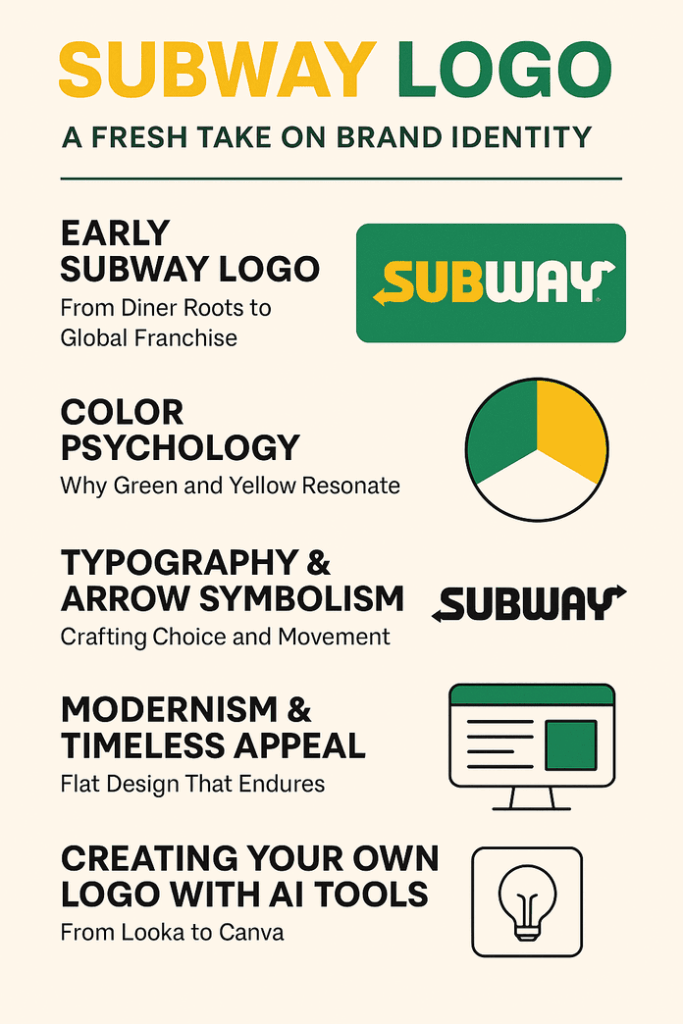
If you want to try a logo along Subway’s lines, here is a straightforward process:
- Choose a platform. Free tools like Looka, Canva and Semplr are easy to use, and most offer downloads without a watermark.
- Define your brand. Enter your business name, industry and style (for example, “modern, green, food”). The more specific you are, the better the results.
- Customize carefully. Adjust fonts, colors and shapes to fit your idea. Subway’s logo works because it is simple, so resist adding more.
- Test it everywhere. Check the logo on business cards, your website and social media, and use a brand kit to keep it consistent.
- Download the right files. Save PNG, SVG and JPEG versions, and check that you have commercial rights to the design so you do not run into legal trouble later.
What Subway Gets Right
Subway’s logo is a good model for effective branding. It is clear, the arrows mean something, and it works on almost anything. The green-and-yellow palette makes a promise and the arrows tell a small story, all in a mark simple enough to draw from memory.
Its weak point is that the promise has sometimes run ahead of the product, and no logo can fix that. If you are designing your own, try drafts in a tool like Looka, Semplr or Canva, keep the version with the clearest idea, and make sure the business can live up to what it says.