The Oreo Logo: From a 1912 Wordmark to Bold Blue
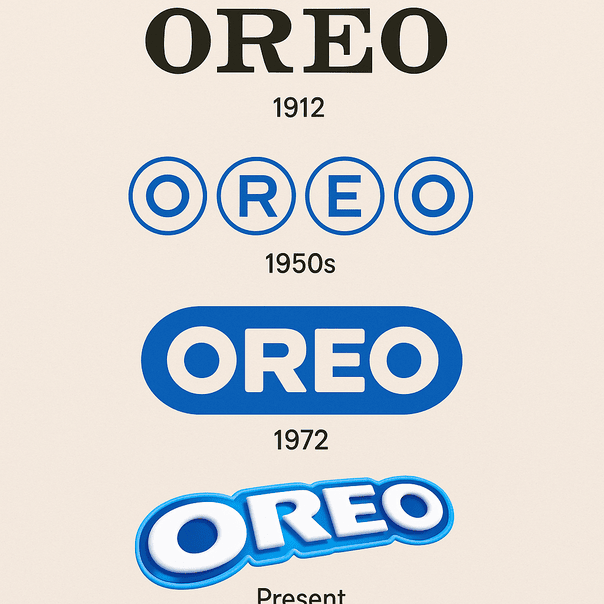
When Nabisco launched the Oreo in 1912, its logo was a stamp rather than a design: a plain wordmark whose only job was to tell you whose cookie you were holding. More than a century later the name sits in heavy, rounded capitals on a deep blue field, and that blue has become as much a part of the cookie as the cream. The route between those two points is a useful lesson in how a brand can keep changing its logo for a hundred years and still look like itself.
A Functional Start
The first Oreo logo was purely practical: a straightforward typeface chosen for legibility rather than charm. It was about as plain as the black-and-white cookie it named. Over the following decades it moved from a modest script to a bold, all-caps sans-serif, and the confidence of the lettering grew along with the brand. By the 1960s the logo had a bright blue background with each letter set in a white circle, a nod to the round cookie. The logo’s history and the cookie’s history really are the same story, told in type.
The lesson from those early years is that a simple start is an advantage. A plain mark leaves room to grow, and even a very modest design can become a cultural fixture if the changes over time are made carefully.
Why Blue
Blue looks sharp next to dark chocolate, but that is not the only reason Oreo leans on it. Blue suggests trust, dependability and calm, which is a good set of feelings to attach to a midnight snack. Blue works almost like a comfort food among colors. Oreo and Pepsi both use it to look reliable while staying friendly.
The 2022 redesign pushed further in the same direction, pairing a deeper blue with heavier type. The result feels nostalgic and modern at once, like a favorite song remixed for a new audience. The point for designers is that a palette is never only decoration. It is the first emotional signal a brand sends.
Type That Holds It Together
Type does in the Oreo logo what the cream does in the cookie. It holds everything together. The 2022 redesign introduced an extra-bold, all-caps sans-serif that is thick and unmistakably modern. It is a confident choice that fits Oreo’s “Stay Playful” positioning. The rounded corners of the letters echo the cookie’s shape, and the clean lines let the logo work on packaging, digital ads and even AR filters.
The design also draws on the feel of the product. The embossed pattern on the cookie, which turns up again and again in Oreo’s marketing, has influenced the logo over time, most obviously in the circles of the 1960s version. That is a good habit to copy: a logo should feel like an extension of the thing it sells.
Circles, Symmetry and a Bit of Lore
Oreo has no monogram in the traditional sense, but its circles and symmetry carry meaning. The embossed pattern on the cookie, with its swirls and flourishes, has long been used to tell the brand’s story. Some people think the early circles were simply a picture of the cookie. Others, as Marketing Dive has reported, connect them to a piece of internet lore about the name itself: O for cookie, RE for cream, O for cookie.
Whether or not that is true, it shows what a logo can do beyond spelling a name. Think about which shapes or motifs can carry the essence of your brand. Oreo’s logo suggests the old ritual, twist, lick, dunk, without saying a word.
How Oreo Stays Current
Staying relevant for more than a century takes good modernist instincts. Each redesign, from the bold overhaul of the 1970s to the 2022 refresh, balances nostalgia against something new. A timeless logo changes without losing its character, and Oreo has managed it by holding on to the core: blue, bold and circular, adjusted for each new decade.
The practical advice follows. Do not chase trends that will be gone faster than a TikTok dance. Put your effort into the things that last: clean lines, flexible colors and some acknowledgment of where the brand came from.
The Logo in Snack Culture
Oreo’s logo has become part of popular culture. It has made cameos in sitcoms and stars in Instagram Reels, and it has helped shape snack culture across several eras. The 1960s logo, with its blue-and-white circles, had the optimism of the Space Age. The 2022 version, sleek and minimal, sits comfortably among clean-label packaging and TikTok aesthetics.
That adaptability makes Oreo a benchmark for playful branding. M&M’s and Skittles owe something to Oreo’s talent for making snacks feel like fun. A good design should create an emotion, whether that is joy, nostalgia or plain indulgence.
Copycats and Controversy
A famous logo attracts imitators, and Oreo has plenty. Knockoffs range from store-brand “sandwich cookies” to overseas copies, and they tend to borrow the blue and the bold lettering, which chips away at Oreo’s brand equity. Much of a logo’s power comes from being the only one of its kind, and every copy erodes that a little.
Oreo’s playful campaigns have caused some debate as well. The “Name This Oreo” audio challenge, launched in 2025, prompted chatter about whether it made light of the brand’s heritage. Still, Oreo has shown it can play along with internet culture without losing its core identity, which is not easy.
The Business Behind the Blue
Mondelez International, Oreo’s parent company, has seen its share price rise steadily, with a market value of around $90 billion in 2025. The Oreo logo plays a real part in that. It shows up consistently on everything from the classic cookie to gluten-free versions, and that consistency drives recognition. NDTV Food reports that Mondelez’s AI-driven product development, including new Oreo flavors, has made the process four to five times faster.
For designers, the takeaway is that a strong logo is a business asset. Whoever designs it, it has to scale across products and markets.
Consistency
Oreo’s identity is as consistent as its cream-to-cookie ratio. The blue, the bold type and the playful tone run through everything from packaging to social media. That consistency builds trust and makes the brand instantly recognizable, whether on a supermarket shelf or in a Snapchat filter.
It is easy to produce many versions of a logo. Choosing one and sticking with it is harder. Make sure the mark matches your brand’s voice, playful like Oreo or sleek like Apple, and then use it the same way everywhere.
What Oreo Teaches Logo Designers
Oreo has three lessons worth keeping. First, versatility: a logo has to look as good on a billboard as it does as a favicon. Second, iteration: Oreo’s logo has been adjusted dozens of times, and each change sharpened the identity a little. Third, fun: Oreo’s playful branding shows that a sense of humor can set a brand apart.
Experiment boldly with color and shape, then edit hard. Plenty of customization is available to anyone now. The difficult part is making something unique.
Twist, Lick, Dunk
Oreo’s visual language is nearly as famous as the logo. The “Stay Playful” platform, pushed further by campaigns like the 2025 “Name This Oreo” challenge, ties the logo to a wider story about fun. The bold, approachable design suits that story, and it looks right on everything from TikTok challenges to Kroger coupons.
A design should amplify the brand’s message, not just carry its name. Test how different fonts and colors change the feeling, playful, sophisticated or edgy, and pick the combination that matches what you want to say.
Oreo on Social Media
The logo is well suited to the internet. Posts on X, such as @MAZZAL33N’s 2021 redesign concept, show how fans play with its look. Hashtags like #Oreo and #StayPlayful trend regularly and spread the logo further, and its clean design stands out on social media, from Instagram Stories to X banners.
For a brand that lives online, that matters a great deal. Design for small screens first. ZDNET has said Shopify’s Hatchful produces cohesive logos that look less generic than most, and whatever you use, the test is whether the mark still reads at the size of a profile picture.
Technology and AI
Mondelez is already using AI. Its in-house tool has helped create more than 70 products, including gluten-free Oreos, which shows how technology can support a brand. Could the logo itself get an AI makeover? Possibly. A generator could adjust the colors or type to match each new flavor.
AI logo generators have made that kind of experiment available to everyone. Turbologo, Logo AI, Looka, Canva, BrandCrowd, Fiverr Logo Maker, Designs.ai, Design.com and Semplr can produce professional-looking logos in seconds, and VistaPrint pitches its tool as smart algorithms combined with core design principles. For a brand like Oreo, the value would be in refining the playful look without losing the heritage, not in replacing either.
More Than a Cookie
Oreo has become much more than a single cookie. The range runs from classic chocolate sandwiches to limited editions such as Lemonade and Gluten-Free Golden, and the logo unites all of them. Mondelez also sells Oreo cakes, ice cream and merchandise, all carrying the same mark. The “Stay Playful” platform reaches into digital experiences too, like the 2025 audio challenge, which ties the products to interactive campaigns.
This is where a unified brand pays off. A logo has to scale from packaging to merchandise without losing its character.
Oreo Against Chips Ahoy and Hydrox
Next to competitors like Chips Ahoy and Hydrox, Oreo’s logo stands out for its bold simplicity. Chips Ahoy goes folksy, with a handwritten feel, and Hydrox is more utilitarian. Oreo’s blue, all-caps design feels premium and friendly at the same time, a balance few rivals manage. It stands out without shouting.
That is the sweet spot to aim for: distinctive, but not overdesigned. Look at the shelf your product will sit on and make sure your mark is the one people can pick out from across the aisle.
If Oreo Tried an AI Logo Generator
As a thought experiment, imagine Oreo’s design team brainstorming with one of those tools. They would type in “playful,” “blue” and “cookie-inspired” and get back dozens of clean, downloadable options ready to try on packaging. The likely result would keep the classic Oreo look and adjust the type for a TikTok-minded audience.
The exercise is speculative, but it shows where these tools fit. For Oreo, they could make it easier to produce variations for each new flavor, while the core logo stays where it is.
Oreo in the News
In 2025 Oreo’s big campaign was “Name This Oreo,” an audio challenge created by VML that turned the brand’s name into a game. Mondelez’s AI-driven flavor development, including gluten-free Oreos, also kept the brand in the news. Both show Oreo combining heritage with new technology and keeping the logo in the conversation.
The same year brought a legal fight over exactly the kind of imitation described above. Mondelez International, the company behind Oreo, Chips Ahoy and Wheat Thins, is suing Aldi in an Illinois federal court, alleging that the supermarket’s store-brand snacks copy its packaging to mislead shoppers. The suit, filed on May 27, 2025, says Aldi’s look-alike designs, such as blue packs of chocolate sandwich cookies and gold boxes of Thin Wheat crackers, dilute Mondelez’s brand identity and threaten irreparable harm. Mondelez is asking for damages and a court order to stop what it calls trademark infringement. It is the latest in a long line of legal disputes over Aldi’s copycat packaging.
What the Oreo Logo Shows
The Oreo logo shows how far a plain wordmark can travel. It started as a label, took on a color in the 1960s, and has spent the decades since getting bolder and simpler without ever being thrown out. The Aldi case is a backhanded compliment: the blue is now so strongly tied to Oreo that a rival’s blue pack can be argued in court to be confusing. That is about as much as any logo can achieve.