The Dell Logo: Lessons From the Blue Circle
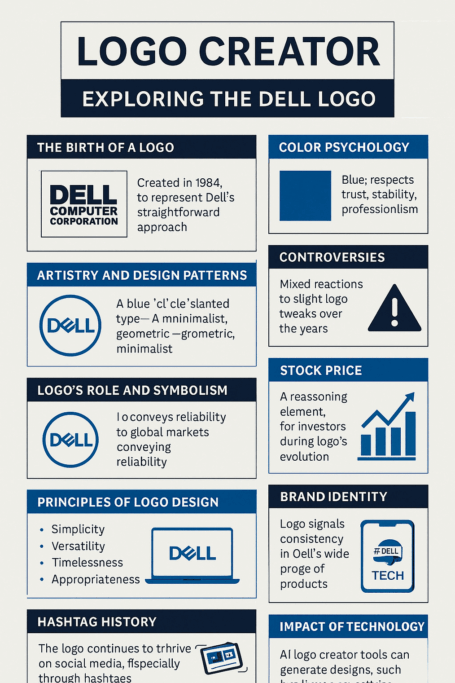
Dell’s logo is so plain it could pass for a drinks coaster: a blue circle with “DELL” inside and the E tipped on its side. That plainness has carried the company from a college dorm in 1984 to a business worth around $100 billion, through a decade of falling share prices, a buyout and a return to the stock market. Few corporate logos have been asked to do so much while looking so calm.
From a Dorm Room to Dell Computer
In 1984 Michael Dell was a freshman in Austin, assembling PCs in his dorm room under the name PC’s Limited. The first logo was a blocky, typewriter-style design, the kind of thing you would expect from a student business. It wasn’t pretty, but it was honest, much like the budget computers it was selling.
In 1987 PC’s Limited became Dell Computer Corporation, and the logo was redesigned. The result was the blue circle with “DELL” set inside on a slant, a design that suggested ambition without any showing off. The goal was clarity and trust. Dell wasn’t competing with Apple on artistic flair. It wanted to be the reliable choice, and the logo said so years before anyone had heard of an AI logo creator.
Why Blue
Blue is the most common color in corporate identity for a reason. It reads as trustworthy, calm and professional, which is why so many tech companies and banks use it. Dell’s shade is deep and slightly muted, neither icy nor stuffy, which suits a brand selling dependability to office workers.
Next to Apple’s sleek silver or HP’s brighter cyan, Dell’s blue is the steady option, the one an IT manager can choose without having to justify it. If you are picking colors for a brand of your own, decide first what you want people to feel: blue for trust, red for passion, green for growth. Then test the options in real contexts before you settle.
A Circle, a Word and a Slant
That is the whole logo, and its simplicity is the secret. Every element counts. The circle, an old symbol of unity and completeness, holds the word like a shield. The tilted E adds a sense of speed and movement to an otherwise static shape.
The design meets every standard test of a good logo. It scales, looking sharp on a laptop lid or the side of a building. It is versatile, working in color or grayscale. And it is memorable: once you have seen it you know it. Compare Pepsi, which has redesigned its swirl repeatedly. Dell’s logo has simply ignored trends.
When the Circle Caused Trouble
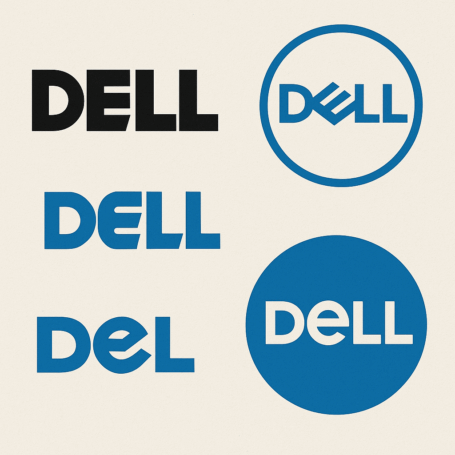
People get attached to logos, and they react when they think one is about to change. In 2010, after Dell bought Perot Systems, rumors of a logo update spread online under the hashtag #DellLogoFail, and fans protested a change that, according to the original reports, never happened. Familiar logos feel like family heirlooms, and touching them starts arguments.
There was another scare in 2016 during the EMC merger, when talk of a logo overhaul unsettled investors and briefly pushed the stock down. Dell left the circle alone. Sometimes leaving a logo untouched is the boldest choice available, and these episodes show how much the mark anchors the brand.
The Logo Through the Share Price Swings
A logo can’t move markets, but it is the face of the company, and faces matter. Dell’s stock has swung wildly, from about $25 in the early 2000s down to $8 in 2012, and then past $100 by 2025. Through all of that the logo stayed exactly the same. Investors buy trust rather than logos, and a familiar mark is a quick reminder of it.
When Dell went private in 2013, the unchanged logo reassured customers and partners. When it returned to public markets in 2018, the same circle signaled that the company was still itself. The logo didn’t lift the share price, but it was one of the few things that never wobbled.
A Logo for Every Era of Computing
Dell’s logo maps onto the history of the industry. The 1980s version was rough, like the early PC boom. The refined 1990s version suited a company growing globally and taking on IBM. In the 2000s it sat on consumer-friendly Inspiron laptops, and now it connects Dell’s hardware roots to its work in cloud computing.
PCs, laptops and servers have all carried the same mark, and it has fitted every one of them. That flexibility is the real lesson: a logo has to keep working as the products change, without losing what made it recognizable. If you want a starting point for a mark that can grow like that, an AI logo generator such as Semplr can give you a set of simple drafts to work from.
What the Circle Means
Circles suggest wholeness, community and continuity, which fits a company whose business is connecting people through technology. The slanted E adds a little energy and suggests progress without bragging. It is a logo with ambition that it keeps quiet about.
Nike’s swoosh means motion and Apple’s apple hints at knowledge. Dell’s circle is more understated and more universal, and it works in the 180 countries where the company sells. Simple shapes like this cross cultures easily, which is worth remembering if you hope to sell abroad.
The Logo in Everyday Life
Logos don’t change history, but they do shape how we experience it. Dell’s circle is on millions of machines in classrooms and offices, and for many people it was on the first computer they used. A familiar, friendly mark helped make computing feel less intimidating.
The plain design also gives Dell room for other messages, such as its recycling push around 2020. A busy logo would compete with those campaigns. A simple one lets the message come through, which shows how a logo can carry a company’s values without having to spell them out.
Practical Modernism
Modernist logos put simplicity and function first, the Bauhaus approach applied to branding. Dell’s sans-serif lettering and geometric circle fit that tradition and leave behind the ornate logos of an earlier era, such as vintage Coca-Cola. It is less adventurous than Google’s shifting wordmark. Call it modernism for everyday use: practical rather than precious.
The Rules, Followed
Dell’s logo is a textbook case of the basic principles of logo design:
- Simplicity: one circle, one word.
- Versatility: it works on screens and on merchandise.
- Timelessness: it has lasted decades.
- Memorability: people recognize it instantly.
- Appropriateness: blue suits a technology company selling reliability.
It isn’t flashy, and it doesn’t need to be. It works, and those five checks are a good test for any logo you design.
The Glue of the Brand
Dell sells laptops, servers and software, and the logo holds that large business together. From budget Vostro machines to Alienware gaming rigs, it signals the same promise of quality. That consistency builds trust in a way that brands which keep swapping logos (Pepsi again) never quite manage. Pick a logo that can scale with your plans, and then keep it.
Anatomy of the Logo
VistaPrint’s breakdown of the Dell logo is a useful way to look at it:
- Logomark: the circle, standing for unity.
- Wordmark: “DELL” in a bold sans-serif.
- Color: blue, for trust.
- Composition: balanced and stable, like a pyramid.
The circle anchors the design, and the slanted letter gives it energy. Every part does a job, and none of it is decoration.
What the Logo Says
Without any words beyond the name, the logo says steady, innovative and here to stay. The circle carries the stability, the slant the progress and the blue the trust. It doesn’t shout. Where Apple built a brand on “Think different,” Dell’s logo quietly says “work smarter,” which suits a company that has always sold on practicality.
Hashtags and Screens
The logo has done well online, from #DellTech in the 2000s to #DellInnovate in 2025. Its simple shape makes a crisp avatar on Twitter or Instagram, with no detail to turn to mush at small sizes. Any new logo should be checked the same way, as a tiny profile picture as well as at full size.
Growth Without a Redesign
Dell’s growth from a dorm-room startup to a $100 billion company owes something to its logo. As the company moved into servers, storage and cloud services, the circle stayed constant and told customers that the new products came from the same Dell. That is how a logo should support growth: new products, same promise.
Technology and the Circle
Dell’s first logos were drawn by hand. Today software, including AI tools that analyze design trends, could produce something with the same simplicity in seconds. But the logo existed long before those tools, and its strength comes from the decisions behind it: the color, the tilted letter, and the discipline to leave it alone. Software can imitate the result. It can’t make those decisions for you.
The Circle That Stayed
Dell’s logo is simple and still effective, quiet and still authoritative. It has come through changes in technology, wild swings in the share price and a few online storms, and it still looks like a dependable company that sells practical machines. For designers it is a lesson in restraint. For businesses it is a reminder that a plain mark, used consistently for decades, can be worth more than a clever one that keeps changing.