The Chupa Chups Logo: Salvador Dalí’s Daisy
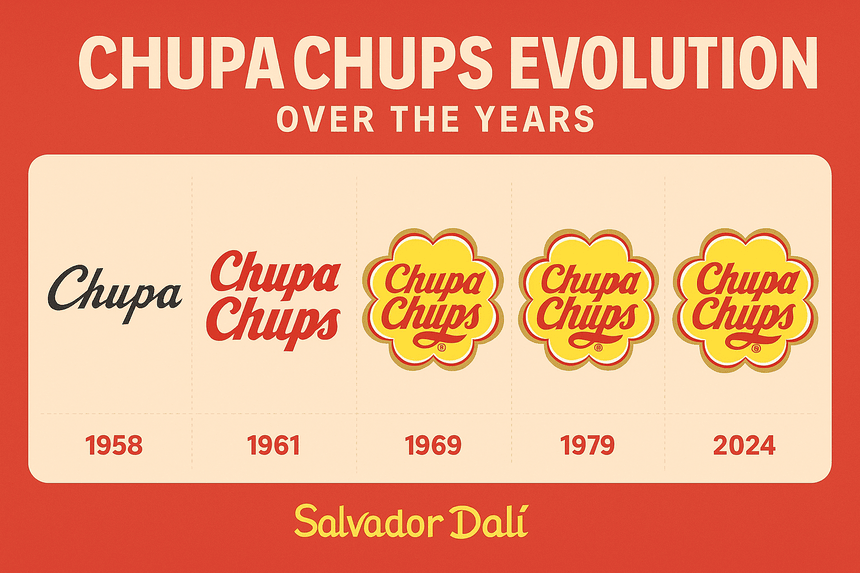
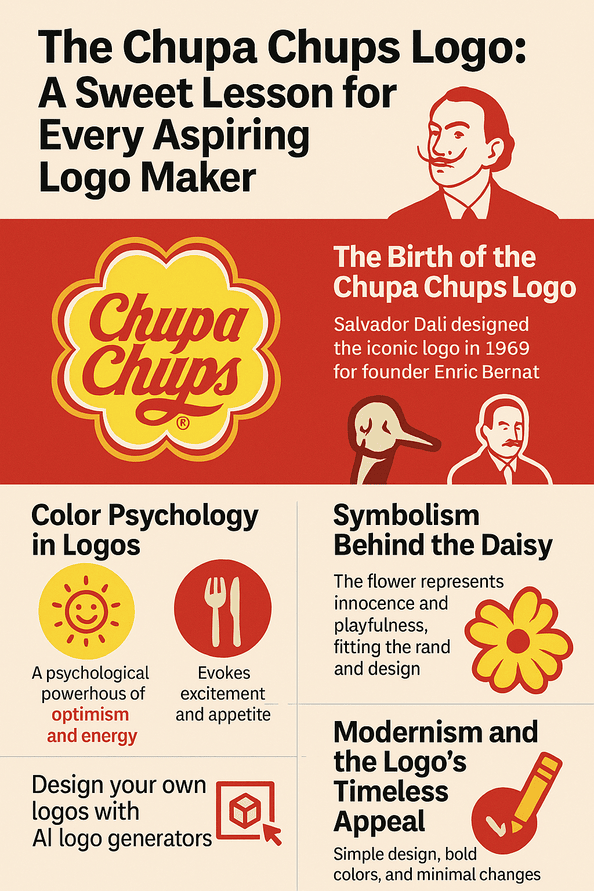
The yellow daisy on every Chupa Chups wrapper was drawn by Salvador Dalí, reportedly in about an hour at a café in 1969. It has barely changed since, which tells you something about how right he got it. It is a rare case of a famous artist designing a mass-market logo and producing something that works as a logo rather than as a signed artwork: bright, simple and placed exactly where it needs to be.
For a lollipop, that is a lot of design history. It also holds up as a set of lessons for anyone making a logo today, whether they start with a sketchpad or a piece of software.
A Candy on a Stick, Then a Surrealist
In 1958 Enric Bernat, a Spanish confectioner, noticed a problem: children got sticky hands from ordinary sweets, and their parents were not happy about it. His answer was a candy on a stick. He named it Chupa Chups, from the Spanish verb chupar, to suck. By 1969 the brand was doing well, and Bernat wanted a logo that matched his international plans. He went to Salvador Dalí, the surrealist best known for melting clocks and an extravagant mustache.
The story goes that Dalí sketched the daisy on a newspaper during about an hour at a café. He also insisted that the logo sit on top of the lollipop wrapper, so it would stay visible even as the sweet was unwrapped. The result was a bright yellow daisy holding the Chupa Chups name in red. It was simple, striking and memorable, and it is still close to the original more than half a century later. That placement decision is arguably as clever as the drawing.
Yellow and Red
The colors are doing much of the work. Bright yellow reads as optimism and energy. Red suggests excitement and appetite. In the usual reading of color psychology, yellow grabs attention and feels warm, which suits a brand tied so closely to childhood treats. Red stimulates hunger (fast-food chains rely on it for that reason) and adds a sense of urgency, a nudge to unwrap the thing now.
Color is felt before shape is processed, and this combination is a big part of why the logo is recognizable from across a shop. It is not an accident. The lesson for designers is that colors persuade as well as decorate, so pick ones that match the brand’s personality, playful like Chupa Chups or sleek like a tech startup.
The Daisy and the Lettering
The logo gets a lot out of very little. The daisy is playful but structured, its petals radiating like a child’s drawing of the sun. The lettering was originally a mix of antique serifs and handwritten curls. In 1988 it was streamlined into one bold typeface, with a handwritten “s” kept for a bit of whimsy. That balance of order and play is a large part of why the logo still looks current. It works on a billboard or on a wrapper the size of a coin, and it still has a personality.
Modern logo advice says simplicity matters most, and that personality matters too. Plenty of generic logos follow the first rule and forget the second, ending up clean and forgettable. The Chupa Chups logo shows that you can add some quirk without clutter. The daisy is a symbol of joy as much as a shape, a nod to the carefree pleasure of a lollipop.
Why a Daisy
Dalí’s choice of flower was not random. Daisies stand for innocence, purity and play, which suits a brand aimed at children and at adults who remember being children. The flower’s radial symmetry also mirrors the round head of the lollipop, so the logo and the product share a shape. Dalí’s skill was in reducing the brand to one image nobody forgets. Symbols matter, and the best ones tell the brand’s story at a glance, whether they are drawn by hand or roughed out on screen.
A 1969 Design That Still Looks New
The logo is something of a paradox: a 1969 design that looks as fresh now as it did then. Its modernism is in its simplicity, with clean lines, bold colors and a shape that sits outside trends. Compare it with the overworked logos of many AI startups, with their generic swirl motifs and a sameness that comes from everyone copying everyone else. Chupa Chups avoids that by not trying too hard, and its playfulness is unapologetic.
Anyone building a logo should take the point. Gradients and 3D effects are tempting, but a logo that lasts does not chase fashion. The Chupa Chups logo has stayed largely the same since 1969, with only minor changes in 1988, which shows that a great design does not need constant reinvention.
Shaping Candy Culture
Chupa Chups did more than sell lollipops. It helped shape candy culture, and its logo turned up on everything from wrappers to billboards. The brand’s playful tone led to campaigns like “Stop smoking, start sucking,” a cheeky 1980s effort that parodied cigarette packs with mock warnings such as “Sucking does not kill.” That irreverence made Chupa Chups a brand that does not take itself too seriously, which fits today’s meme-driven internet well.
Among playful brands, Chupa Chups is a reference point. It sells a feeling as much as a product. A logo should aim to make people feel something, whether that is nostalgia, joy or a little rebellion.
Knockoffs and Protection
Famous logos get copied, and Chupa Chups is no exception. Knockoff lollipops have imitated the daisy for years, chipping away at its exclusivity, and modern design tools make it even easier for copycats to produce lookalikes. Perfetti Van Melle, the brand’s parent company, has protected its intellectual property hard, so the daisy remains tied to the real thing.
Originality matters for every brand, not just famous ones. A generic logo risks fading into the background or being ripped off. If you use a template tool such as Designs.ai or Fiverr Logo Maker, customize it heavily. Chupa Chups’ distinctiveness is its protection, and every brand should aim for the same.
The Business Value of a Daisy
The success is financial as well as cultural. Perfetti Van Melle bought Chupa Chups in 2006, and the brand’s global reach, with over 100 flavors sold in 150 countries, owes a lot to its logo. Perfetti Van Melle is privately held, so there is no stock price to point to, but the logo has clearly built brand value. Big confectionery and snack companies, PepsiCo among Perfetti’s competitors, use branding in the same way to run their businesses more efficiently, and the daisy plays that role here.
For any business the takeaway is that a strong logo drives growth as well as looking good. Recognition brings sales and loyalty, whether you sell lollipops or laptops.
The Same Daisy Everywhere
Consistency is the brand’s real secret. The daisy is on every wrapper and every social media post, reinforcing the identity each time. That is why it feels like an old friend whether you see it in a Tokyo convenience store or a London sweet shop. A logo’s main job is to identify, and Chupa Chups uses its daisy to tie together a large range of products.
For a new brand, consistency starts with a small set of matching assets, from the logo to business cards, used the same way every time.
Design Lessons
What can the Chupa Chups logo teach designers? First, simplicity is powerful. Dalí’s design shows you do not need complexity to make an impact. Second, know your audience: the playful look appeals to children and adults alike. Third, placement matters, and putting the logo on top of the wrapper was a brilliant branding decision. Finally, use color psychology to get the right emotional response.
These principles hold however you work. Quick tools such as Hatchful or BrandCrowd help you try ideas fast, but the logo’s history shows that human insight, like Dalí’s instinct about placement, is what lifts a good design to a great one.
Sucking, Not Smoking
The logo is part of a wider visual language. From the “Stop smoking, start sucking” campaign to the daisy itself, Chupa Chups’ messaging is bold but friendly, and getting that balance right is what makes a playful brand work. The logo’s simplicity lets it fit any context, from packaging to anti-smoking parodies.
For logo makers the message is to match the visuals to the brand’s voice. Software can generate designs quickly, but it is up to you to make sure they say something true about the brand.
The Daisy Online
The logo has found a second life on social media. Posts on X regularly bring up its Dalí origins, with accounts like @DesignReviewed pointing to how well it has lasted. Hashtags such as #ChupaChups and #Branding spread it further. The modern lesson is to make something people want to share. A logo that stands out on Instagram or TikTok is worth a great deal.
Could AI Have Drawn It?
Could software have produced the Chupa Chups logo? Not in 1969, obviously, but today’s tools are getting closer. AI logo generators such as Looka, Semplr and Canva can turn out logos in seconds, with plenty of customization, and Looka can produce hundreds of designs from a brand name and a few style preferences. What none of them has is Dalí’s surreal spark. These tools have opened up design to startups and solo founders, which is useful. The Chupa Chups logo is a reminder that they are tools, not a substitute for an idea.
More Than Lollipops
Under Perfetti Van Melle, Chupa Chups sells more than 100 flavors, from classic strawberry to cola. It has also moved into merchandise such as T-shirts and backpacks, all carrying the daisy. Limited-edition collaborations, including some with fashion brands, keep the logo visible in pop culture. A strong logo can hold a wide portfolio together, and this one does.
Against Dum Dums and Tootsie Pop
Next to its rivals, the Chupa Chups logo comes out ahead. The Dum Dums logo, colorful and cartoonish, feels juvenile by comparison. Tootsie Pop’s owl-based design is memorable but less flexible. Chupa Chups wins on universal appeal and minimal elegance. In candy branding, as in most branding, less really is more.
A Hypothetical Redesign
Imagine Chupa Chups in 2025 needing a logo variation for a limited-edition flavor. The team types “playful, candy, daisy-inspired” into a tool like BrandCrowd and gets a pile of designs back, some with neon twists and some with 3D effects. None of them has the magic of the original. So the team reworks the output, adding a handwritten font and nudging the yellow to a sunnier shade, and ends up with something that refers back to Dalí while feeling new. The point of the exercise is that software can help with the legwork, but the decisions that matter are still made by people.
Chupa Chups in 2025
Recent news about Chupa Chups has centered on sustainability. In 2024 Perfetti Van Melle announced eco-friendly packaging plans, linking the daisy to greener values. Social campaigns on X promote new flavors like matcha and yuzu. The Dalí connection keeps drawing attention too, with regular posts about the logo’s artistic roots. The brand is still changing while keeping its most famous asset untouched.
The newest product is Chupa Chups Apple Laces, a green apple jelly candy in lace-like strips that children and adults can tie, weave and wrap before eating. Brand Manager Kim McMahon has pointed to their potential in the UK’s growing jellies market, another sign that Chupa Chups is about more than lollipops.
What Dalí Got Right
Dalí got three things right in about an hour: a shape that matched the product, colors that could be spotted across a shop, and a position on the wrapper that kept the logo in view. Everything Chupa Chups has done since has been built on those choices, and the company has been wise enough to leave them alone.
If you are designing a logo for your own brand, the lesson is not to hire a surrealist. It is to think about where the logo will actually live, on a product, a sign or a phone screen, and design for that place first. Keep it simple, make it memorable, and give it a story worth telling.