The Chipotle Logo: History, Color and Design Lessons
Chipotle now has more than 3,700 restaurants, and every one of them is marked by the same thing it started with in Denver in 1993: a single chili pepper and a plain typeface. Very few restaurant chains have grown that much while changing their logo so little. The pepper has been cleaned up, put in a badge and printed on everything from foil wrappers to investor decks, but it has never been replaced, and the company has never seemed tempted to replace it.
That restraint is the interesting part. Fast food logos tend to come with mascots, crowns, clowns and slogans. Chipotle picked one ingredient and let it stand for the whole menu.
A Pepper and a Typeface, 1993
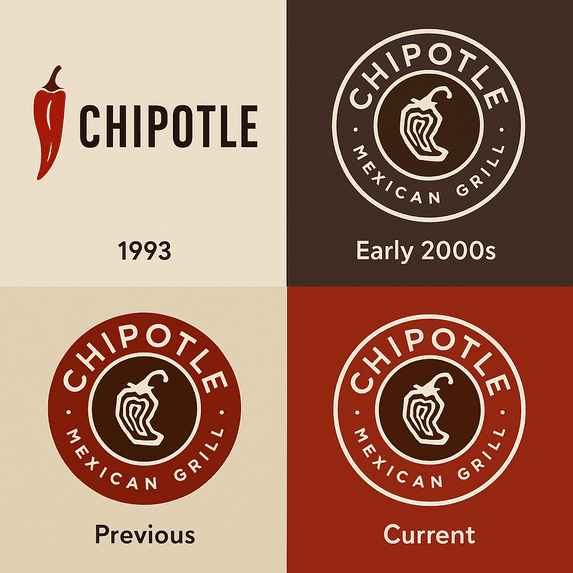
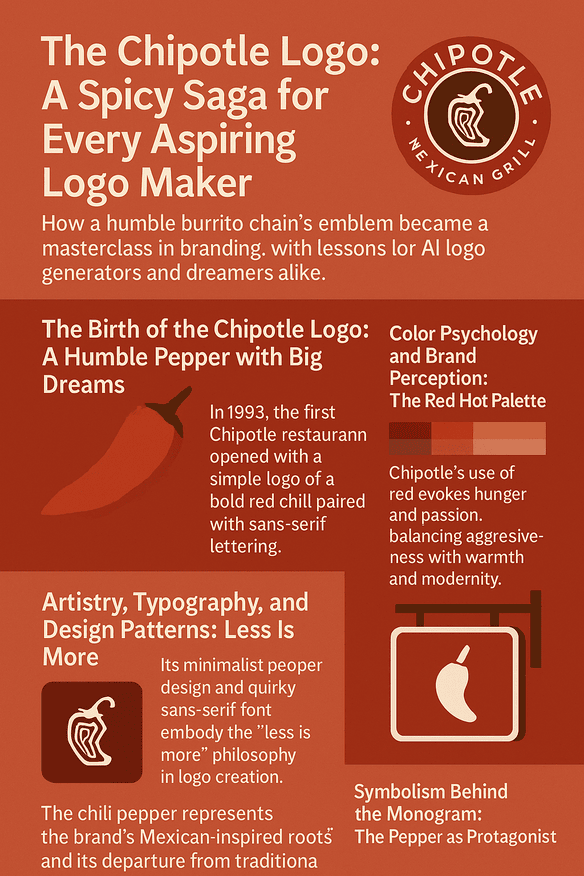
Steve Ells opened the first Chipotle Mexican Grill in Denver in 1993, selling large burritos at around $5 at a time when fast food meant burgers and fries. The original logo was about as simple as a restaurant sign can be: a red chili pepper, drawn boldly, next to a no-nonsense sans-serif name. It did not look like a taco chain. It looked like a place that wanted to be taken a little more seriously than one.
As Chipotle grew from a single shop into a national chain, the logo was refined rather than reinvented. By the early 2000s it had settled into a circular badge with a cleaner pepper and a typeface that felt friendlier and less blunt. The rawness of the first version, which had a slightly homemade, punk-ish quality, was smoothed out, but the idea underneath it stayed exactly the same.
That idea came from Ells’ “food with integrity” pitch. The menu was short and built on fresh ingredients, and the logo said the same thing in visual form: one ingredient, shown plainly, with nothing added. If you are starting a logo of your own, this is the first thing to copy. Begin with one strong idea and give it room, instead of trying to fit the whole business into a single mark.
Why the Red Works
Red is the obvious color for a food brand, and Chipotle uses it well. Red is associated with appetite, urgency and heat, which is why it turns up in so many restaurant logos, from Pizza Hut’s red roof to KFC’s bucket-red branding. For Chipotle it has a more literal meaning too: it is the color of ripe chilies and of a salsa hot enough to make your eyes water.
What keeps it from feeling aggressive is the shade. Chipotle’s red is not a fire-engine red. It is deeper and earthier, closer to dried chili than to a stop sign, so it reads as warm rather than loud. That small difference matters. A brighter red would have pushed the brand toward the cheap, fast end of the market, which is exactly where Chipotle did not want to be. The same color has to sit comfortably on a $10 bowl and on the materials for a company whose stock was trading at $51.19 in June 2025, and it does.
The general point is that a color should tell part of the story. Blue tends to suggest trust, purple creativity, green health. Chipotle’s red suggests spice, freshness and a little danger, all of them things the brand wants you to associate with lunch.
The Drawing and the Lettering
The pepper itself is a good lesson in how much detail to leave out. It is stylized almost to the point of abstraction, closer to a Matisse paper cutout than to a botanical illustration. There are no seeds, no shine, no shading to show the skin. The curves are full but controlled, and the shape is recognizable at a glance, which is all a restaurant sign needs to do.
The lettering is just as deliberate. Chipotle’s current logo uses a custom sans-serif that is bold without being heavy and has just enough personality to feel human. It does its job and stays out of the way of the pepper. That is a harder balance than it looks. A typeface with too much character competes with the symbol; one with too little makes the whole logo feel generic.
This is also where design tools tend to lead people astray. A logo generator will hand you hundreds of font and icon combinations in a few minutes, and it is tempting to keep adding. Chipotle’s logo is a pepper, a name and a color. The skill is in choosing what to keep, and in stopping.
What the Pepper Stands For
Next to golden arches and a burger chain’s crown, a single vegetable looks like a deliberate snub. The pepper points to the Mexican-inspired menu, but it also separates Chipotle from the fast food crowd. There is none of the cartoon cheer of a drive-thru menu. The promise is heat and freshness, not convenience.
It also travels well. A chili pepper is specific to Mexican cooking and understood almost everywhere, so the mark works as well in Shippensburg, Pennsylvania as it does in London or Paris. Chipotle never needed a mascot or a slogan in the logo to explain what it sold. The pepper does the explaining.
Modern Without Chasing Trends
The logo has clean lines and a strong color, and it looks as current in 2025 as it did in 1993. That is partly luck and mostly restraint. Because there is so little to the design, there is very little to date it. Logos tend to age through their details: a fashionable gradient, a typeface everybody was using that year, a drop shadow. Chipotle avoided all of them.
The simplicity also lets the logo move into new places without being redrawn, from the Chipotlane drive-thru lanes to digital menu boards and the app. Every so often fans on X speculate about a refresh, usually a bolder pepper or some kind of neon treatment, but as of June 2025 no official redesign had been announced. The company seems to understand that it does not need one.
A Logo for the Fast-Casual Era
Chipotle did not invent the burrito, but it did more than anyone to define fast-casual dining, and its logo became one of the visual markers of the early 2000s, when “fresh” and “sustainable” moved from marketing language to things customers actually asked about. You saw the pepper on college campuses and in city food courts first, then increasingly in suburban strip malls. By 2025 there were more than 3,700 locations, with plans for around 300 more, and the logo is about as familiar as the Starbucks mermaid.
Much of that familiarity is tied to how Chipotle talked about sourcing. The brand made a point of being open about where its food came from, something that mattered to millennial and Gen Z customers, and a logo built from a single plain ingredient suited that message. (The open book does have one famous exception: the extra charge for guacamole.) A logo ends up carrying whatever a company does in public, good or bad.
Copycats and the Appropriation Question
The logo has had its arguments. Local taquerias have borrowed the pepper, and other chains have copied its pared-back look. There is also a more serious debate about culture. Chipotle was founded by a chef who is not Mexican, and critics have argued that the brand, logo included, reduces Mexican food to a tidy, Americanized package. Defenders point to the company’s commitment to sustainable sourcing as a kind of respect for the cuisine.
Both arguments have some weight, and the tension is part of what makes the logo interesting. The pepper celebrates something and simplifies it at the same time. If your own design borrows from a culture that is not yours, expect people to ask about it, and have a better answer ready than “it looked good.” Software can generate culturally themed options all day. It cannot tell you whether they are appropriate.
The Logo as a Business Asset
As of June 2025, Chipotle’s stock was around $51.19, holding up despite a slowdown in same-store sales in the first quarter. The logo appears on everything from burrito wrappers to investor reports, and its consistency has helped carry the company from one Denver shop to a chain with 7,000 locations as its stated target.
Recognition pays off most clearly in digital sales, which made up 35.4% of revenue in the first quarter of 2025. On a phone screen, an app icon has a fraction of a second to register, and a red pepper is about as quick to read as a symbol gets. The same mark also has to work on a Chipotlane sign seen from a moving car. Design for both extremes, the billboard and the app icon, before you settle on anything.
Consistency Across Every Surface
Chipotle is strict about where and how its logo appears. It shows up on menus, packaging, uniforms and even in the company’s hiring tools, including “Ava Cado,” the AI hiring assistant Chipotle says has cut recruitment time by 75%. Seeing the same mark in the same way, over and over, is a large part of what makes people trust a brand. The logo makes a promise about fresh, bold food, and the restaurants have to keep it.
For anyone designing a logo, consistency starts with testing. Put the design on business cards, shopfronts, social posts and packaging mockups before you commit, and look hardest at the places where it struggles. Chipotle shows how far a unified visual identity can take a business: from a burrito shop to something close to a cultural institution.
What Designers Can Take From It
The first lesson is the obvious one. A single strong element, like a pepper, can carry more than a crowded design ever will. The second is color. Chipotle’s red does real work, suggesting hunger and heat while staying warm enough to feel friendly. The third is time. The logo was built to last, not to look fashionable for a year, and it has lasted.
The last lesson is about story. The pepper works because it matches what the company sells and how it wants to be seen: fresh, simple and a bit hotter than expected. A good logo starts from a clear idea of the business. Tools can help you draw it, but they cannot supply the idea.
Marketing in the Same Voice
The logo’s mix of bold and casual carries over into Chipotle’s marketing. It feels like a friend texting “tacos tonight?”, and the promotions are pitched the same way, from the “Summer of Extras” rewards program to free burritos tied to the NBA Finals. The pepper sits on all of it and ties it together. Chipotle has always sold a bit of a lifestyle alongside the food, and the logo is how you recognize it.
A visual language like that should make people feel invited in. Playful or minimal, the logo is where the welcome starts. Chipotle’s version works well enough that it is hard to pass one of its restaurants without thinking about a bowl.
The company is also good at picking up on jokes its customers are already making. Its Friday the 13th campaign grew out of the “tatted like a Chipotle bag” meme about people covered in impulsive tattoos. Chipotle turned it into a buy-one-get-one deal, handing out temporary tattoos and free entrées to fans with ink, real or fake.
Built for Social Media
On social media the pepper turns up constantly. Tags like #ChipotleHacks and #GuacMode fill X with photos of overstuffed burritos, and the logo is usually somewhere in the frame. That happens because the design is clean enough to stay legible in a square Instagram post, a cropped phone photo or a meme with text slapped over it. A busier logo would get lost.
If you are designing a logo now, test it at small sizes and in social formats early. Many logo tools will show you previews in profile pictures and post templates. Chipotle’s logo shows that a design can be shared and remixed endlessly without losing what it is.
Technology and Logo Design
Design software has changed who gets to make a logo. AI logo makers such as Fiverr Logo Maker, Semplr and Designs.AI can produce a clean, modern mark in minutes, suggesting fonts, colors and icons from a short description of the business, usually without a watermark on the download.
These tools work by drawing on huge numbers of existing designs, which makes them good at producing something competent and quick. A logo as plain as Chipotle’s could plausibly come out of one. What they cannot do is decide which of the fifty competent options is right, or know that a deeper red will serve a burrito chain better than a bright one. That judgment is the part of the job that stays human.
Beyond the Burrito
The pepper now covers a lot more than burritos. There are the Chipotlane drive-thrus, and an AI-driven rewards system that sends personalized offers to customers who have stopped coming in. The “Summer of Extras” program, running through August 2025, gave rewards members exclusive badges and free entrées, all branded with the same pepper.
The logo is on merchandise too, from T-shirts to reusable bags, which turns customers into walking advertisements. A logo today has to live on products, inside apps and next to chatbots like Ava Cado, and it has to look right in all of them.
Against Taco Bell, Qdoba and the Rest
Compared with its rivals, Chipotle’s logo looks better the longer you stare at it. Taco Bell’s bell is playful but feels stuck in the 1990s and its late-night drive-thru image. Qdoba’s swirling flames try too hard to look edgy. Del Taco’s sunburst feels like a copy of a copy, and Moe’s Southwest Grill’s logo is too busy to remember.
Chipotle’s wins on clarity: not too much, not too little. It is worth studying the competition in your own field before you design anything, mostly so you know what to avoid. Chipotle did not copy anyone, which is why it stands out on a crowded street.
If Chipotle Used an AI Logo Maker
Suppose Chipotle’s design team typed “Mexican-inspired, fresh, bold” into Looka or Semplr in 2025. They would get dozens of peppers back. Some would be neon red for a Gen Z feel, some hand-drawn for a craft look, some with a heavier font or a gradient behind them. Almost certainly the team would end up where they started: one pepper, a clean typeface and that red.
That is how these tools are best used. They produce options in seconds, but the real work is in the editing. Chipotle’s logo is good because it has been refined over decades, not because anyone kept adding to it. Treat generated logos as a starting point and expect to throw most of them away.
Chipotle in 2025
As of June 2025 the company was planning to open close to one restaurant a day that year, on the way to its 7,000-location goal. Ava Cado was cutting hiring time by 75%, and the “Summer of Extras” promotion was giving away free entrées whenever a coach used a challenge during the NBA Finals.
Rumors of store closures and bankruptcy have been debunked; Chipotle reported revenue up 14.6% year over year to $2.8 billion in March 2025. Talk of a new logo remains just talk. The company’s attention is on expansion and new technology, not on redrawing the pepper, and after more than thirty years the logo still looks like it belongs on the door.
If you want to build a mark with that kind of staying power, a logo maker is a fine place to sketch first ideas. Start with one simple symbol, choose a color for a reason, and keep cutting until only the essential parts are left.