The KFC Logo: How the Colonel’s Face Became a Brand
KFC is one of very few global fast-food chains whose logo is a real man’s face. Colonel Harland Sanders has looked out from the brand’s signs since the 1950s, and every redesign since has had to answer the same question: how much of the Colonel to keep. The answer has always been most of him. The bow tie, the glasses and the white goatee have outlasted every typeface and color scheme around them.
How the Colonel Became the Logo
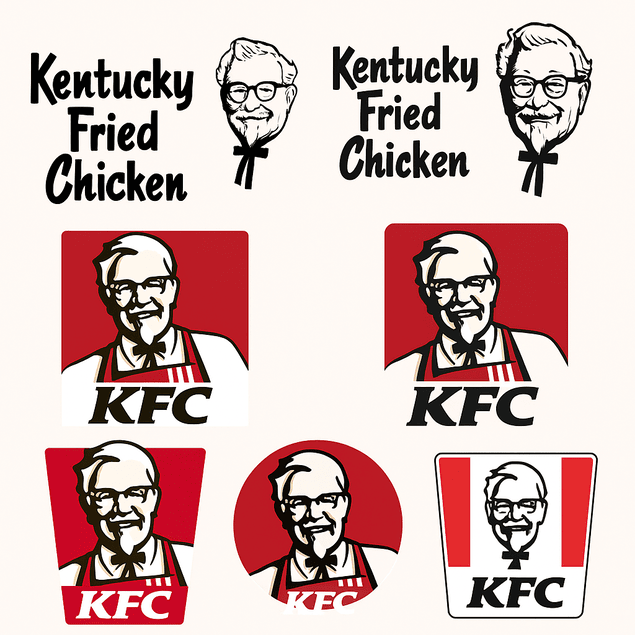
The story starts in Corbin, Kentucky, in 1930, where Sanders was selling fried chicken from a roadside diner. The first KFC logo arrived in the early 1950s and was as plain as the food: a black-and-white sketch of the Colonel’s cheerful face with the words “Kentucky Fried Chicken.” It was folksy and unpretentious, more like a handwritten recipe card than a corporate badge, and it summed up what Sanders wanted the business to be, a seller of high-quality chicken that tasted home-cooked.
By 1959 his face had become the centerpiece of the logo, complete with white suit and black bow tie. Putting a real person on a brand was a bold move, and it worked. The Colonel was more than a mascot. He was a guarantee of quality, and the image made customers feel they were eating at his table. The first lesson for anyone designing a logo comes straight from this: build it on something true about the business.
Why the Red Makes You Hungry
Color psychology does a lot of KFC’s work. The brand’s red, hex code #A3080B, is meant to make you hungry. Red stimulates appetite and a sense of urgency, and KFC has leaned on it since the 1991 redesign introduced the strong red. White adds a feeling of cleanliness, and the 2020 update added a touch of gold to make the brand feel a little more premium.
Colors persuade as well as decorate. Red and white suggest hunger and comfort, and that pairing has helped build loyalty in very different cultures. Choose colors for the feeling you want: red for hunger, or pink for playful branding in the manner of Barbie or Victoria’s Secret Pink.
The Redesigns and the Type
The logo has been reworked many times. The 1978 redesign by Lippincott & Margulies moved the Colonel’s portrait to the left and paired it with a modern serif typeface, giving the brand a sleeker look. In 1997 a square logo showed a tuxedo-clad Colonel against red-and-white stripes, a touch of retro. The 2006 version went bolder and set the Colonel inside a deep red circle, closer to modern minimalism.
The 2020 redesign is the most polished yet. The face is simplified, the type is bolder and the new gold accent appears. It manages to be nostalgic and still look right on Instagram. The slightly rounded, heavy lettering feels approachable, which suits a brand built on comfort food. The balance between character and simplicity is what makes it work: clean enough to read small, but with enough personality that nobody mistakes it for anyone else.
What the Face Means
The Colonel’s face is a symbol of trust. The whole design revolves around that caricature, and it carries the brand’s history and its claim to authenticity. His white goatee and glasses are as recognizable as Mickey Mouse’s ears. Among faceless fast-food logos, a human face makes KFC feel personal, like a handshake from the man himself.
A logo should carry a brand’s core values, whether that is tradition, as with KFC, or something louder, like T-Mobile’s magenta. The way to get there is to work out the brand’s story before choosing a single shape.
Old Face, New Finish
KFC has been good at staying current while keeping its roots. The 2018 redesign was a deliberate return to the company’s origins, mixing nostalgia and modernity in a way that worked for longtime fans and new customers alike. The 2020 update went further and streamlined the Colonel’s face so it would sit cleanly on social media and delivery apps. It is the same record, remastered.
That balance is the useful part. Keep the logo scalable, versatile and faithful to where it came from. KFC’s works on billboards and fry boxes because it is simple and still distinctive, and any logo should look as good on a phone screen as on a storefront.
The Logo Across Fast-Food Eras
The logo has tracked the fast-food business. The 1950s version had postwar optimism; the 1991 redesign’s strong red belonged to the louder 1990s; the 2020 update is built for digital-first branding and TikTok. Each redesign has adapted to the market without losing the core, which is how KFC has stayed relevant from the era of drive-thrus to the era of delivery apps.
Logos need to evolve. If KFC had kept its 1950s black-and-white sketch, it might have faded like an old photo left in the sun. The trick is to change the finish and keep the face.
Stolen Images and an AI Ad
KFC has had its controversies. In 2022 it took on image theft with a joke, launching “Chickenstock,” a site that gave away high-resolution chicken photos to discourage unauthorized use. More recently, a 2025 AI-generated KFC ad caused a row when it turned out to have borrowed shots from real KFC commercials, which raised ethical questions about AI in branding. Filmmaker Joris Noordenbos was skeptical of claims that the AI content had been storyboarded by hand.
The lesson is simple. Originality is not optional. Knockoffs and designs that lean too heavily on someone else’s work can land a brand in legal trouble, or at least in a pile-on online, and anything produced by software deserves the same check for originality as anything drawn by hand.
The Logo and the Business
A good logo also earns money. KFC’s parent company, Yum! Brands, has grown steadily, and its stock price rose 12% in 2024, helped in part by strong branding. The logo’s consistency has supported KFC’s global expansion, from Kentucky to Kathmandu, to more than 25,000 locations. The digital-friendly 2020 redesign helped KFC’s online presence and its delivery sales during the pandemic.
The stakes are real at any size. A well-designed logo can add to a brand’s value whether it belongs to a startup or a global chain.
Consistency Across Platforms
The logo holds the brand together. From buckets to billboards, the Colonel’s face makes KFC instantly recognizable. The company’s brand guidelines specify colors and fonts so that the logo is used consistently in every market, which is why KFC feels like KFC in Tokyo and in Texas.
Consistency is the rule to copy. A logo should work on business cards and TikTok profiles alike, and it is worth previewing it on mockups of both before deciding.
Lessons From the KFC Logo
The KFC logo offers four practical lessons:
- Keep it simple. The minimal 2020 logo shows how much can be removed.
- Use your history. The Colonel’s face ties KFC to its origins.
- Choose colors deliberately. Red and white make KFC stand out; pick colors that suit your brand.
- Stay adaptable. KFC’s redesigns changed a lot without losing the identity.
None of these needs a big budget. They need a clear idea of what the brand is and the discipline to keep it.
The Slogan and the Visual Language
KFC’s slogan, “Finger-Lickin’ Good,” is as famous as its logo. Combined with the Colonel’s friendly face, it creates a visual language that is warm, indulgent and a little cheeky. The red circle and bold type add to that and make KFC feel like a party you have been invited to. The logo and slogan together describe the experience of eating the chicken: satisfying and a bit greasy, in a good way.
A logo should speak the same language as the brand’s messaging. If you want a playful brand, KFC is a good model, and so is something like Jungl’s whimsical green logo. Fonts and colors should match the tone of everything else the brand says.
The Colonel on Social Media
Online, the logo does well. Hashtags like #KFC and #FingerLickinGood have millions of posts, and the Colonel’s face turns up in memes and TikToks. The clean 2020 design was made for digital use and fits neatly into Instagram Stories and delivery-app icons. In 2025 KFC went after Gen Alpha humor with deliberately bizarre, chaotic memes of dancing chickens, and engagement went up.
A logo has to be optimized for small screens and social feeds. If the face or the lettering turns to mush at icon size, it needs work.
AI and Logo Design
AI tools have changed logo design. AI logo generators such as Looka, Semplr and DesignEvo produce hundreds of variations in seconds, which makes professional-looking logos affordable for almost anyone. KFC’s 2020 redesign probably benefited from digital tools that let designers refine the Colonel’s face precisely. The 2025 ad controversy shows the risks, though. Originality has to come first.
It is easy to imagine KFC’s own team trying a generator for a refresh, typing in “heritage,” “fried chicken” and “Colonel Sanders” and adjusting the red and white for appetite appeal. The software might suggest a neon-pink Colonel for laughs. The team would almost certainly end up with something close to the 2020 logo, clean and bold. That is the honest value of these tools: they produce options quickly, and a person who understands the brand still has to choose. Nobody should expect software to match the Colonel’s charm on its own.
On Products and Merchandise
The logo is not just for buckets. It is on fries, wraps and delivery boxes, and on limited-edition merchandise like the Colonel Sanders Cat Climber. The menu now includes plant-based options and regional specialties, and the logo ties them all together. KFC’s recent push toward Gen Alpha with chaotic social campaigns shows how far the same face can stretch.
A logo should scale across products and platforms. Test it on packaging, clothing and anything else it might end up on.
KFC Against the Other Fast-Food Giants
Next to McDonald’s golden arches or Burger King’s blue-and-red bun, KFC’s logo stands out for its human element. The Colonel’s face has a warmth that McDonald’s minimal arches lack, while Burger King’s playful rebrand feels trendier but less personal. KFC’s red-and-white palette is close to Wendy’s, but the Colonel gives it an edge in authenticity.
Studying competitors is part of the job. The point is to find the element that sets you apart, as KFC found its mix of heritage and modernity.
KFC in 2025
In 2025 KFC made headlines with an AI-generated ad that borrowed footage from real commercials. At the same time its social media has been as busy as ever, with Skibidi Toilet references and dancing-chicken memes aimed at Gen Alpha. Both show that the logo is not a static picture. It is an active part of the brand’s digital strategy, for better and worse.
The Colonel has been redrawn, recolored, boxed, circled and flattened for seventy years, and he still looks like himself. That is the real achievement of the KFC logo. A face is harder to modernize than a shape, and KFC has managed it by changing everything around him and as little of him as possible.