The Harley-Davidson Logo: The Bar and Shield Since 1910
Harley-Davidson built motorcycles for seven years before it had an official logo. When the Bar & Shield arrived in 1910, it looked less like a piece of branding than a license plate bolted to a badge, and that plainness is exactly why it has lasted. More than a century on, the same basic shape is tattooed on forearms, stitched onto leather jackets and printed on refrigerators, and it still stands for a particular American idea of rebellion, freedom and brotherhood on the road.
The logo’s history is also a practical guide for anyone designing a mark today, whether they start with a pencil or a logo generator. Its structure, its symbols and its staying power are all worth studying.
The First Bar & Shield, 1903 to 1910
William S. Harley and Arthur Davidson founded the company in 1903 in a small shed in Milwaukee, Wisconsin, with help from Arthur’s brothers Walter and William. For its first seven years the company had no official logo. That changed in 1910 with the Bar & Shield, the design that laid the foundation for everything since.
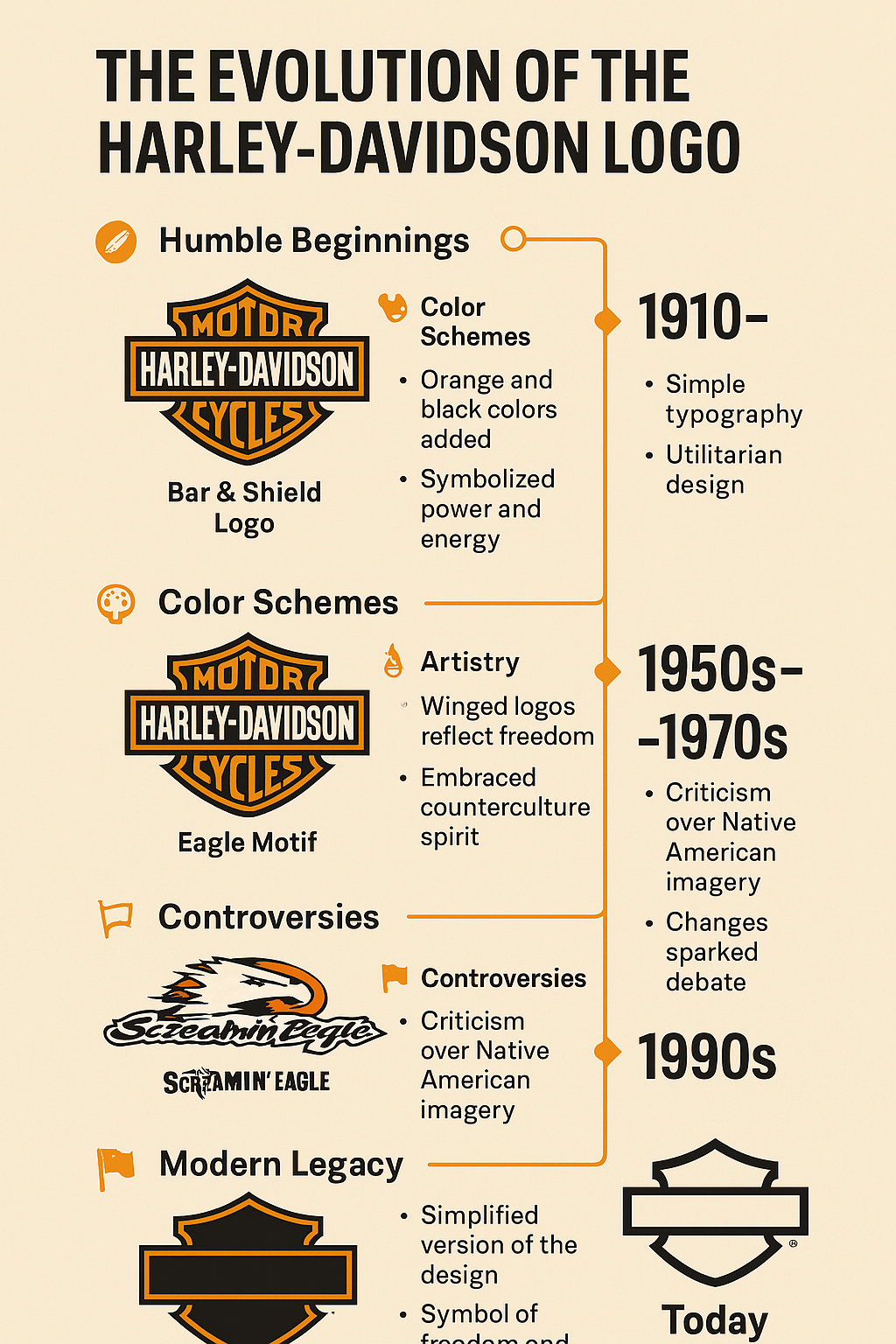
It was strikingly simple: a shield-shaped background with a horizontal bar across it, carrying the words “Harley-Davidson” in bold capitals. The shield had a metallic tone that suited the industrial mood of the early twentieth century, and the bar resembled a license plate, a practical choice given how few tools there were for branding vehicles at the time. The shield stood for protection and strength. The design was patented in 1911. It was born out of necessity, but it carried a strength that matched the rough, mechanical spirit of early motorcycling.
The original had three defining features:
- Type: bold, all-capital serif lettering.
- Color: monochrome, usually black on white or on metal.
- Style: industrial, practical and easy to read, in keeping with a utilitarian era.
Crude as it was, this version became the base of one of the best-known logos in business history. Its simplicity is still what designers aim for when they want a brand to be clear at a glance.
Color, From Monochrome to Orange and Black
Color has shaped how the logo looks and how it feels. The 1910 design used only black, white and gray, which suited the manufacturing limits of the time and the no-nonsense attitude of early riders.
1933: Orange and Black
The first big color change came in 1933, when Harley adopted orange and black. Orange suggested energy, adventure and vitality. Black suggested power, rebellion and a certain sophistication. Together they captured the brand’s double personality, rugged but refined, and over time the pairing became as recognizable as the shield itself. It is still one of the most copied combinations in branding, and many design tools now ship with preset palettes for moods like power, excitement or nostalgia that owe something to Harley’s choice.
The palette has shifted since. The 1953 logo for the company’s 50th anniversary added silver to mark the occasion. A 1965 redesign went back to a stark black and white for a more modern look. Today the logo usually combines orange, black and white, although a minimal gray-and-black version appeared in 2019, part of a move toward a simpler, more contemporary look. Each of these changes reinforced the brand’s personality for a new generation of riders.
From Industrial to Iconic
The 1930s to the 1950s
After the Great Depression, Harley leaned harder on patriotism and freedom. Eagles, wings and chrome entered its graphics, reflecting the hopes of working-class America. The core of the logo stayed the same, though, and that balance between plain structure and decoration is the logo’s real strength. The Bar & Shield itself is clean geometry, lines and shapes that read as strong without any clutter. Early versions used a traditional, blocky typeface that felt solid; later ones moved to custom lettering with sharper, more confident lines.
The “Willie G Skull”
The “Willie G Skull,” usually credited to Willie G. Davidson, was never an official logo, but it became a central part of Harley’s visual world, especially among people who build custom bikes. Its gritty, countercultural look is now easy to imitate with software in seconds, which says something about how far design tools have come, and also about how much of the skull’s power came from the people who wore it rather than from the drawing.
Controversies
Trademark Fights
Harley-Davidson protects its brand aggressively. It has sued many vendors and clothing shops for using the Bar & Shield without permission.
Cultural Backlash
In the 1990s and 2000s Harley drew criticism for designs that leaned on Native American imagery, such as the “Screaming Eagle.” The company said it meant to honor that heritage; critics called it cultural appropriation.
The 2019 Textless Version
In 2019 Harley released a version of the logo with no text, just the outline of the shield and bar. It was sleek and modern, but some loyal riders felt it watered down the logo’s history. That reaction is common when a heritage brand simplifies, and it is worth expecting before you strip your own logo down.
A Logo That Tracks American Eras
Each version of the logo says something about the country as well as the company.
1910s to 1930s
- Industrial America and support for the war effort
- Simple, mechanical logos
1940s and 1950s
- The boom after World War II
- Patriotism and chrome
1960s and 1970s
- The counterculture
- Skull logos and “Live to Ride” slogans
1980s and 1990s
- Expansion into fashion and lifestyle products
- More wings and more playful typography
2000s to Today
- Anniversary editions, such as the 100th in 2003
- A move toward minimal, screen-ready designs
The lesson holds for any new brand, however its logo is made: a mark that ignores the culture around it will feel out of place, while one that responds to it without abandoning its core can last for generations.
Anatomy of the Modern Logo
Broken into its parts, the logo looks like this:
| Element | Meaning |
|---|---|
| Bar | The strength and backbone of the brand |
| Shield | Protection, legacy and tradition |
| Typography | Capital serif letters for stability and power |
| Color | Black and orange for rebellion and energy |
| Negative space | Visual balance that directs attention |
Set out like that, it is clear how much meaning a minimal design can hold when every part has a job.
From Subculture to Global Brand
Subcultures
The logo became a badge of rebellion for several very different groups:
- Outlaw biker gangs
- Counterculture youth
- Military veterans
Film
It turned up prominently in films including:
- Easy Rider (1969)
- The Wild One (1953)
- Terminator 2 (1991)
Fashion and Merchandise
Designers such as John Varvatos have made collections around the logo, and it appears on everything from rings to refrigerators. That range is the real test of a logo’s scalability. If a mark keeps its force on a leather jacket, a coffee mug and a phone screen, it is doing its job, and that is the standard every logo template is quietly trying to reach.
What the Logo Says
The message has hardly changed in a century: freedom, endurance, boldness and brotherhood. Even reduced to the bare outline with no text, as in 2019, the logo keeps that voice. Few brands get to the point where the shape alone is enough. Harley has.
The Bar & Shield on Social Media
Online, the logo shows up in a few predictable places:
- Tattoos (#HarleyTattoo)
- Bike modifications (#BarAndShield)
- Fashion (#HarleyStyle)
- Brand campaigns (#ScrewItLetsRide, #LiveYourLegend)
If you are designing for YouTube or social media, remember that the logo has to shrink and still be readable. The Bar & Shield passes that test because its outline is so distinctive.
Design Lessons
Any brand or designer, working by hand or with software, can take four lessons from the logo.
Keep It Simple
The shield and bar are easy to reproduce and easy to remember. Don’t overcomplicate a mark that has to work everywhere.
Hold On to the Core Symbols
Eagles, shields and bars have stayed while everything around them changed.
Move With the Times
Harley has added chrome, skulls and wings over the decades without losing the core shape, balancing tradition and trend.
Be Consistent but Flexible
Keep the essence and change the details when you need to. That applies to heritage brands and new startups alike.
What Comes Next
As Harley moves into electric motorcycles with LiveWire, the logo faces some new tests.
A Greener Identity
Green accents, simpler shields or imagery about energy are all possible.
Screens
App icons, favicons and motion graphics all need versions of the logo that scale and respond to their setting.
Personalization
The logo may become part of personalized digital experiences, changing color or overlays on a bike’s dashboard display or in a smart helmet.
A Logo Built to Last
The Harley-Davidson logo is a good model of lasting branding. Its history follows design trends, American ideals and the feelings people attach to the open road. From its 1910 debut to the stripped-down 2019 version, it has been through color changes, new artwork and controversy, and it has come out each time still recognizably itself. Its symbolism made it a global icon, and its construction is a study in balance.
It has gone from factory stamping to fashion runways and from outlaw culture to electric bikes. Software can now produce a convincing shield in seconds, but the Harley logo is a reminder that what makes a brand last is emotion, identity and a story people want to be part of, and those come from people.
If you want to start a mark of your own, Semplr’s free AI logo generator is a quick place to begin. For another long-lived logo built on visual storytelling, see our look at the evolution of the Coca-Cola logo.