What Marvel’s Logo Teaches About Lasting Design
The Marvel logo most people know is a red rectangle with MARVEL knocked out in white, and it only dates from 2002. Before that, the company went through a shield, a corner box, slanted italics and a red-and-yellow 1990s mess, and its history is a good map of what works in a logo and what doesn’t. The current mark now flashes up before films that have grossed more than $30 billion, which makes it one of the most widely seen logos in entertainment.
From Timely to Marvel
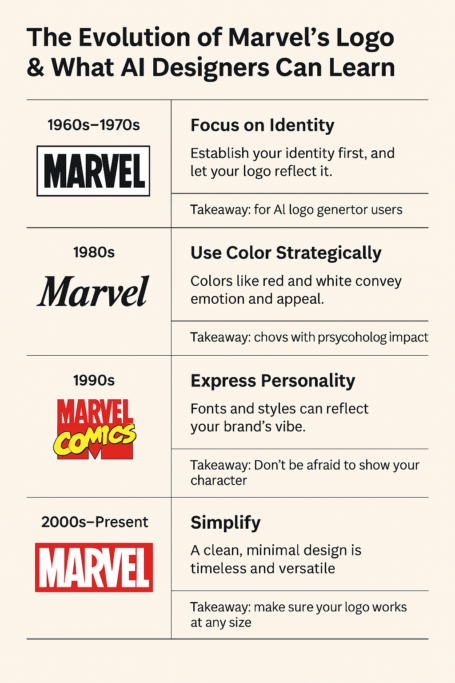
Before Marvel was Marvel, it was Timely Comics, a pulp publisher founded in 1939 by Martin Goodman. Timely’s logo was a plain shield reading “Timely Comics Inc.” in blue and white. It was purely functional and had none of the drama of the stories inside. By 1961 the company was calling itself Marvel Comics, and the logo took its first real step: a boxy “MC” stack, replaced in 1963 by a bold “Marvel Comics Group” masthead.
That early mark was a promise of excitement, its blocky letters borrowed from newspaper headlines. It was not refined, but it was clear, and clarity is what a first logo needs. Polish can come later. A brief as simple as “bold, adventurous, comic-book” would have produced something similar.
Why Red
The modern logo, settled in 2002, is a crimson slab with stark white letters. Red is the most urgent color there is: exciting, loud and hard to ignore. It also happens to be all over Marvel’s characters, from Iron Man’s armor to Spider-Man’s suit, so the logo looks like it belongs to the same family as the heroes.
The white lettering supplies clarity and contrast. Compare earlier versions: the black-and-white italics of 1987 suggested motion, and the red-and-yellow 1990s logo looked like a teenager had been let loose on it. The current design is calmer than either, and stronger for it. Color in a logo does more than decorate. It sets the tone of the story before the story begins.
Type Through the Decades
Typography is a logo’s costume, and Marvel has changed costume several times. The early logos used heavy, newsprint-style lettering that matched comic book mastheads. In the late 1980s Marvel adopted italics for a forward-leaning, kinetic feel. The 1990s brought the strangest experiment: a red “Marvel” with a yellow “Comics” and a swollen “M” that had the energy of a garage-band flyer. It was cluttered and chaotic, and very much of its moment.
In 2002 designers Cyrus Highsmith and Tobias Frere-Jones gave Marvel its modern look, later refined by Rian Hughes in 2012: a geometric sans-serif on a red rectangle. It is clean, bold and scalable, and it reads as serious without being dull. Getting the typeface right for the era is half the job. Small details matter too. The spacing between letters in the current logo is noticeably tight, and it is part of why the word reads as a single block.
A Frame for Stories
The red rectangle works as a frame, a little window into the stories. The white MARVEL inside is a statement of confidence, and its careful kerning, including the tight join between the V and the E, gives it finish. A good logo feels like an invitation, and this one invites you into a whole universe of heroes and villains. It now appears well beyond comics, on movie screens, theme park rides and a great deal of fan art.
Modernism That Lasts
The 2002 logo is properly modernist: no gradients, no chrome, just a bold slab. It is the sort of reduction Dieter Rams might have approved of. In 2016 Marvel added “Studios” in black, separated by clean dividers, which gave the mark a cinematic symmetry without cutting it off from its comic roots.
That balance between continuity and change is why the logo has held up. DC’s logo, by contrast, has swung between gothic and minimal, and Image Comics keeps changing its look. Marvel has adjusted its mark without losing its character, which is the harder thing to pull off.
A Logo for Each Era
Each version of the logo reflects its moment. In the 1960s Marvel’s comics pushed against conservative norms. In the 1980s and 1990s, as superhero comics boomed, the logo went bold and flashy. In the 2000s, with the rise of the Marvel Cinematic Universe, it became a cinematic badge shown before billion-dollar films.
The 2016 “Studios” rebrand marked the shift from page to screen, in an age when a logo has to work as a Netflix thumbnail and on an IMAX screen. As The Hollywood Reporter noted in 2023, Marvel’s brand equity, logo included, helped the MCU gross more than $30 billion worldwide.
Trademarks and Purists
In 2008 Marvel trademarked its red-and-white slab, which raised the question of whether anyone can own a color combination. Marvel’s argument was that what it owned was not the colors themselves but the overall visual impression, a smart legal position. In 2016 the “Studios” addition upset some comics purists, who worried the brand was drifting away from its roots. Record box office numbers settled that argument. The broader point for designers is that a mark should be distinctive enough to defend in law.
The Logo as an Asset
When Disney bought Marvel for $4 billion in 2009, the logo became a mark of trust across films, theme parks and merchandise. Disney’s stock has since risen from about $28 in 2009 to more than $120 in 2025, with MCU films, each opening on that red logo, driving billions in revenue.
Bloomberg reported in 2025 on Marvel’s move into streaming, with the logo opening Disney+ series such as Agatha All Along. A logo at this scale is a financial asset as much as a piece of design, and investors read it that way.
Consistency
Through every tweak, the logo has kept its red-and-white core, and that ties comics, films and merchandise together. Marty Neumeier’s definition of a brand, “a person’s gut feeling about a product, service, or company,” fits here: Marvel’s logo triggers the same feeling wherever it appears. Campaigns like the 2025 Thunderbolts teaser, with its logo-centered animation, show how much the company relies on the mark online.
Five Lessons from the Marvel Logo
- Simplicity. The red slab works at any size, from a comic cover to an IMAX screen.
- Personality. Each version reflects the mood of its era.
- Adaptability. It moves from print to digital without trouble.
- Consistency. The red-and-white core holds the brand together.
- Resonance. It suggests heroism before the story starts.
What the Logo Says
The red says get ready for action. The white says you can trust what follows. The heavy type says this is a serious operation. On X, posts such as @MarvelStudios’ 2025 teaser for Captain America: Brave New World show the logo alone can set off fan excitement under hashtags like #MarvelLogo. People react to it before they see a single frame.
Online and Everywhere
In 2020 fans filled X with AI-generated remixes of the logo, and #MarvelLogo trended globally. By 2025 its animated intros were all over TikTok and Instagram, in fan edits as well as official MCU teasers. It is iconic enough to be treated with respect and loose enough to be turned into memes, which is a rare combination for a corporate mark.
Technology and the Marvel Logo
The logo has moved with the technology of each period. The early versions were inked by hand. By the 2000s, design software made crisp, scalable artwork routine. Today AI logo generators let anyone produce a red-slab design in seconds by typing in a few words. That levels the field for small brands, though it also explains why so many new logos look alike.
It is easy to picture Marvel’s own team experimenting this way, with a prompt like “red, bold, heroic, cinematic.” The results might include a neon version for Gen Z or a 3D version for VR. Most would be discarded. The ones worth keeping would be the ones closest to the current slab, which says a lot about how well the 2002 design was judged.
One Logo, Many Products
The logo fronts comics, MCU films, Disney+ series, theme park rides and merchandise from Funko Pops to Spider-Man sneakers. Variety reported in 2025 on Marvel’s push into games, with the logo on upcoming titles such as Marvel’s Wolverine. Across $30 billion in box office and about $1 billion a year in merchandise, the same red block holds it all together.
Marvel Against DC, Image and Dark Horse
DC’s minimal circular “DC” mark feels corporate and lacks Marvel’s warmth. Image Comics’ constantly changing designs favor flexibility over consistency. Dark Horse’s logo is gritty but niche. Marvel’s red slab comes out ahead for its simplicity and broad appeal, and it is the one the others are usually measured against.
Making Your Own Logo
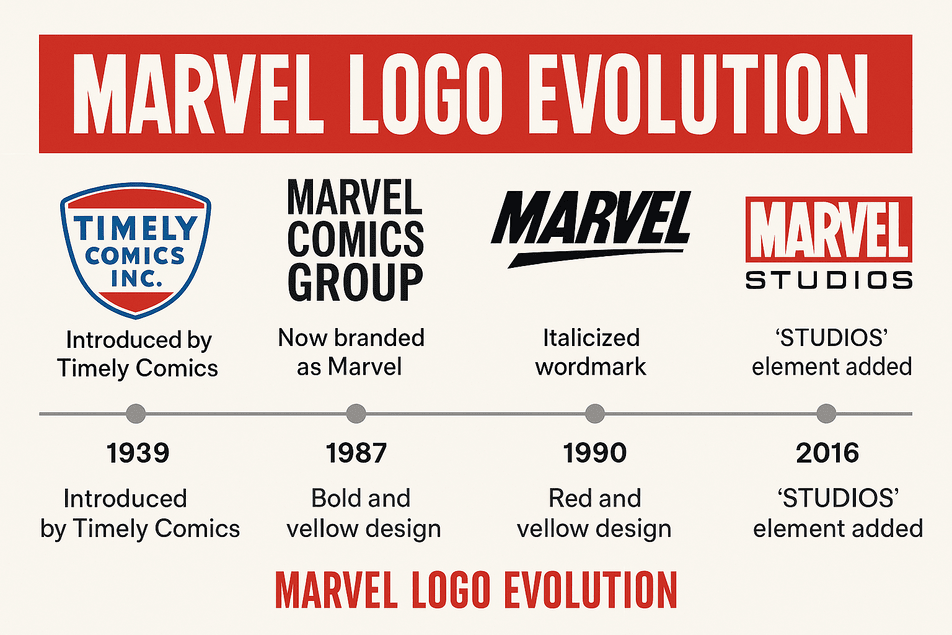
If you are designing a logo with Marvel in mind, the steps are much the same whether you work by hand or with an AI tool such as Semplr:
- Define the brand first. Write down three words for how it should feel, such as bold, heroic and direct.
- Pick colors for what they suggest: red for action, white for trust.
- Simplify. Marvel’s logo shows how little you need.
- Test it everywhere: on an app icon, on merchandise and in social posts.
- Refine, then stop. Iterate until it works, and then leave it alone.
What the Red Block Gets Right
From Timely’s modest shield to the slab that opens every MCU film, Marvel’s logo has changed a lot and kept its character. Some of the in-between versions were bad, and the 1990s one in particular has not aged well. But the company eventually found a design simple enough to survive any medium, and it has had the sense to stop fiddling with it.
Excelsior.
Try Semplr’s free AI logo generator by prompt at semplr.com.
Related reading: our breakdown of Toblerone’s logo evolution.